Limited Time: Free 2-hour ADHD Coaching Session, in exchange for honest feedback to help shape my practice. Spaces are very limited. Register your interest

Navigation Home About Services Pricing FAQ Resources Contact For Professionals Training Policies Privacy Policy Terms & Conditions Safeguarding Equality & Diversity Confidentiality Clinical Governance Book
Nurse-Led · Remote · ADHD-Only ·

Your mind works
differently.
So do we.

Distinctive Minds Clinical offers specialist ADHD coaching and clinical training, delivered by a Registered Mental Health Nurse with over 18 years of clinical experience. Fully remote. Built by someone who understands from the inside.

Book
18+ Years Clinical Experience
RMN Registered Mental Health Nurse
100% Remote & Flexible
What We Offer

ADHD Coaching & Training

  • Post-diagnosis ADHD coaching and support
  • Personalised strategies for work, life & relationships
  • Psychoeducation and strengths-based tools

🌿 Specialist ADHD-only scope, deep expertise, not a general service
Wired to Coach

Wired to Coach

The Clinical ADHD Coaching Intensive for healthcare professionals and accredited ADHD coaches. AuDHD informed. Remote delivery.

ADHD Coaching

Practical, whole-person coaching that looks at how your ADHD interacts with your mood, sleep, anxiety, and medication. Build strategies around the full picture, not just focus.

💊

Titration Coaching

Non-medical coaching to help you track your medication response and build prescriber-ready data, entirely separate from and alongside clinical prescribing.

How it works

From first curiosity to ongoing support, here is what the pathway looks like at Distinctive Minds Clinical.
01
📞

Discovery Call

A free 30-minute call to talk through what you are looking for, answer your questions, and confirm we are the right fit. No pressure, no commitment.

Free · 30 minutes
02

ADHD Coaching

Evidence-based, one-to-one coaching to build strategies, understand your patterns, and develop tools that work with your brain.

From £125 · 60 minutes
03

Coaching and Support

Post-diagnosis coaching to build strategies, understand your patterns, and develop tools that work with your brain. Available as single sessions or packages.

From £125 · 60 minutes
04
🌿

Ongoing Care

Medication support, titration coaching, annual reviews, and ongoing management as your needs evolve. Flexible, consistent, and always one-to-one.

Ongoing · Flexible
Discovery Call Assessment Coaching Ongoing Care

You do not need to follow every step. Coaching is available without an assessment if you already have a diagnosis. Start wherever makes sense for you.

Start with a Free Discovery Call
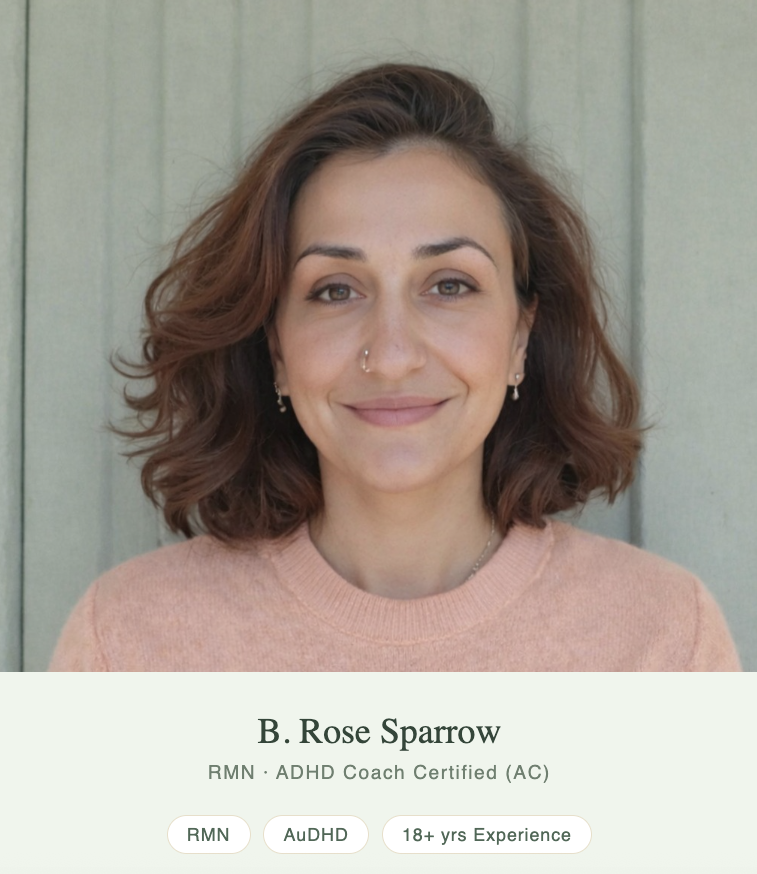
B. Rose Sparrow
B. Rose Sparrow
RMN · ADHD Coach Certified (AC)
RMN AuDHD 18+ yrs Experience

Led by someone who understands from the inside

Distinctive Minds Clinical is founded and run by B. Rose Sparrow, a Registered Mental Health Nurse, ADHD Coach Certified (AC) with over 18 years of clinical experience.

As an AuDHD individual herself, Rose brings both professional expertise and lived understanding to every assessment and coaching relationship. This isn't just clinical knowledge, it's a deeply personal commitment to neurodivergent care that is compassionate, non-judgemental, and genuinely useful.

Her approach is grounded in evidence-based practice, shaped by real-world ADHD experience, and delivered with the warmth and directness that neurodivergent clients actually need.

Our Services

Everything within our specialist ADHD scope, nothing outside it. We do one thing and we do it well.

NMC Registered NICE NG87 Aligned Access to Work Accepted AuDHD Informed Fully Remote

You probably have questions

We hear the same things from most people before they reach out. Here are a few quick answers.

Do I need a diagnosis to access coaching?

No. Coaching is available to anyone who suspects they have ADHD or who has already been diagnosed. A diagnosis is not required to start.

How many coaching sessions will I need?

Most clients start with a 6-session package. We discuss what feels right during your free discovery call based on your goals and situation.

Where do sessions take place?

All sessions are fully remote via Carepatron. You can join from anywhere in the UK on any device.

Is ADHD coaching the same as therapy?

No. Coaching is forward-focused and practical. It builds skills and strategies rather than processing the past. It can work alongside therapy but is a different approach.

Transparent Pricing

No hidden fees. No unnecessary packages. Just honest, fair pricing for specialist clinical care.

Free

Discovery Call

Free

30 minutes · no commitment

Most Popular

ADHD Coaching

£125

per session · 60 minutes

Package

Wellbeing Coaching

Whole-person · burnout and overwhelm

£510

6 sessions · save £240

What clients say

Real words from real people. As Distinctive Minds Clinical grows, this is where client experiences will live.

"
★★★★★

This space is reserved for a client testimonial. Once Distinctive Minds Clinical begins seeing clients, real experiences will be shared here with permission.

A
Assessment client
Coming soon
"
★★★★★

This space is reserved for a client testimonial. Coaching clients will be invited to share their experiences once they have had time to see the impact of their work.

C
Coaching client
Coming soon
"
★★★★★

This space is reserved for a client testimonial. All testimonials on this site are shared with the explicit written consent of the client and may be anonymised on request.

T
Titration coaching client
Coming soon

All testimonials are shared with explicit written consent. Clients may request anonymisation at any time. Testimonials reflect individual experiences and do not constitute clinical endorsement.

Ready to understand your brain?

A free 30-minute discovery call is the first step, no commitment, no pressure. Just a conversation.

From the Blog

🧠
Understanding ADHD

ADHD is not laziness: why executive dysfunction is a neurological reality

The executive function myth that holds so many people back from getting the support they need.

Read more
🔥
ADHD Burnout

ADHD burnout vs depression: understanding the difference

They can look similar from the outside, but they have different roots, and different paths through.

Read more
🌿
Strategies

Body-doubling, temptation bundling, and other ADHD strategies that work

A practical look at evidence-based ADHD strategies, and why some work better than others.

Read more →

The person behind the practice

B. Rose Sparrow brings over 18 years of clinical expertise, and lived neurodivergent experience, to every client she works with.

B. Rose Sparrow
B. Rose Sparrow
RMN · ADHD Coach Certified (AC) ·
Qualification Registered Mental Health Nurse (NMC registered, )
Experience 18+ years clinical
Prescribing
ADHD Training Takeda Trained Certified
Lived experience AuDHD
Delivery 100% Remote

Clinical expertise meets lived understanding

I'm B. Rose Sparrow, a Registered Mental Health Nurse, and the founder of Distinctive Minds Clinical. I've worked in mental health settings for over 18 years, and for much of that time, I watched clients struggle with systems that simply weren't designed with their neurology in mind.

I identify as AuDHD, and that lived experience shapes everything about how I practise. I understand what it's like to sit in a clinical setting and feel like your way of thinking is a problem to be managed, rather than a difference to be understood. Distinctive Minds Clinical exists because that experience shouldn't be normal.

My practice is deliberately specialist. ADHD only. Remote. Solo. That's an intentional choice, it means I can give every client genuine depth of expertise, rather than spreading myself across conditions I'm not trained to assess.

I'm currently completing an Enhanced Clinical Practitioner Apprenticeship (Level 6), building on my foundation in mental health nursing, ADHD assessment, and non-medical prescribing. I hold a Level 3 in Anatomy, Physiology & Pathology and a Level 2 Certificate in Counselling Skills, tools I use daily in this work.

Specialist Depth

ADHD only. We go deep rather than broad, and that expertise shows in the quality of care.

Lived Experience

AuDHD-led practice means we understand the lived reality, not just the diagnostic criteria.

Clinical Rigour

Gold-standard assessment tools, independent prescribing, and NMC-registered clinical governance.

Human-first Care

Every interaction is built around you, your pace, your needs, your brain.

Built on a solid clinical foundation

🏥

Registered Mental Health Nurse

NMC-registered RMN with 18+ years of clinical experience across mental health settings.

💊

Qualified to initiate, titrate and review ADHD medication independently within clinical governance frameworks.

🎓

Takeda ADHD Certified

Certified through the Takeda ADHD training programme, specialist ADHD clinical training.

🧠

ADHD Coach Certified (AC)

Accredited ADHD Coach certification, delivering evidence-based coaching within an ADHD-specialist framework.

Anatomy, Physiology & Pathology

Level 3 qualification underpinning safe prescribing and physical health monitoring.

💬

Counselling Skills (L2)

Level 2 Certificate in Counselling Skills supporting person-centred therapeutic communication.

Let's have a conversation

Book a free 30-minute discovery call to find out if Distinctive Minds Clinical is the right fit for you.

Specialist ADHD care, start to finish

From first suspicion to post-diagnosis support, everything within our ADHD-only scope, delivered with clinical expertise and lived understanding.

ADHD Coaching

Post-diagnosis coaching (or standalone, if you already have a diagnosis) designed to help you build a life that works with your neurodivergent brain. This isn't generic life coaching, it's grounded in clinical ADHD knowledge and informed by lived AuDHD experience.

Sessions are flexible, structured to your needs, and entirely remote. We work on the things that matter most to you: executive function, relationships, work, routines, or anything else that ADHD is affecting.

What's Included
  • Initial goals and needs assessment
  • Personalised 60-minute coaching sessions
  • Strengths-based ADHD strategies
  • Executive function and planning tools
  • Psychoeducation and skill-building
  • Session notes and resource pack
  • Flexible scheduling Tue/Wed/Thu/Sat

ADHD Coaching

Strategies built around your actual brain

"I stopped trying to be neurotypical and started building systems I can actually use."

Non-Medical Titration Coaching

Starting or adjusting ADHD medication can feel uncertain. Non-medical titration coaching helps you track your medication response systematically, logging focus, mood, sleep, appetite, side effects, and anxiety across the day, so you can bring structured, useful data to your prescriber rather than a vague sense that something is off.

This is a coaching service, not a clinical one. It sits alongside your prescribing, not instead of it. The goal is to help you become an expert in your own pattern so that every prescribing conversation is more productive.

What's Included
  • Daily symptom and medication response tracking framework
  • Mood, sleep, focus, and anxiety pattern recognition
  • Side effect logging and timeline mapping
  • Medication rebound and therapeutic window identification
  • Prescriber-ready data summaries
  • Psychoeducation on how ADHD medication works
  • Support navigating medication-related anxiety

Important: Non-medical titration coaching does not involve prescribing, medication adjustment, or clinical decision-making. All prescribing decisions remain with your prescriber. This service helps you track and communicate your experience only.

Titration Coaching

Turn your lived experience into prescriber-ready data

"I finally had something useful to bring to my prescriber instead of just saying it does not feel right."

12 Week Coaching and Titration Package

A comprehensive 12-week programme combining ADHD coaching and non-medical titration coaching. Designed for clients who are navigating medication titration alongside building lasting ADHD strategies.

The 12 Week Intensive gives you the structure, consistency, and clinical depth to make real progress. Eight coaching sessions build your skills and strategies while four titration sessions track your medication response and support your prescriber liaison.

  • 8 x ADHD coaching sessions covering executive function, emotional regulation, and self-advocacy
  • 4 x titration coaching sessions with structured medication tracking
  • 4-week medication diary and therapeutic window identification
  • Prescriber liaison support throughout
  • Session summary notes and between-session email support
  • Free discovery call included
Package Details
Duration 12 weeks
Coaching sessions 8 x 60 minutes
Titration sessions 4 x 60 minutes
Package price £1,295
You save £265 vs pay as you go
Delivery Remote via Carepatron
Discovery call Included free

Wellbeing Coaching Package

A holistic 6-session coaching programme for clients who feel broadly overwhelmed, burnt out, or unsure where to start. Rather than targeting one specific challenge, Wellbeing Coaching takes a whole-person view, looking at sleep, energy, identity, relationships, self-esteem, and daily living alongside ADHD-specific strategies.

This is not about fixing one thing. It is about understanding how ADHD affects every part of your life and building a sustainable foundation from the ground up. The package format provides the consistency and accountability that makes lasting change possible.

  • Executive function and daily structure
  • Emotional regulation and self-compassion
  • Sleep, energy, and routine building
  • Work and relationship strategies
  • Identity, self-esteem, and strengths-based reframing
  • Session summary notes and between-session email support
Package Details
Sessions 6 x 60 minutes
Package price £510
Per session £85
Saving £240 vs pay as you go
Delivery Remote via Carepatron
Discovery call Included free

Assessment and Prescribing Services

Distinctive Minds Clinical is currently focusing on coaching and training. Assessment and prescribing services are in development and will be launching in 2027.

Adult ADHD Assessment

Coming Soon

Comprehensive clinical assessment using DIVA-5, DSM-5, and QbCheck. Full written report to GP and NHS accepted standards. .

inc. QbCheck  ·  Written report  ·  Remote

Prescribing and Medication

Coming Soon

Independent prescribing, medication start and treatment plans, titration follow-up, and annual medication reviews. Launching 2027.

Remote  ·  Launching 2027

Want to be notified when these services launch?

Join the Waitlist

Honest, transparent fees

No hidden costs. No surprises. All sessions delivered remotely via Carepatron.

Pay as you go

All sessions delivered remotely. Payment in advance by Stripe or bank transfer.

Free Discovery Call

30-minute fit check

Free

no commitment required

  • 30-minute video call via Carepatron
  • Understand your needs and confirm fit
  • Outline of your pathway and next steps
  • No obligation to proceed
Book Free Call

Non-Medical Titration Coaching

60-minute medication tracking session

£140

per session

  • Daily symptom and medication response tracking
  • Mood, sleep, focus and anxiety pattern recognition
  • Structured 4-week titration diary
  • Prescriber liaison support
  • Therapeutic window identification
Book Session

Better value, better outcomes

Packages provide consistency and structure. All packages include a free discovery call.

Wellbeing Coaching

Whole-person coaching for burnout and overwhelm

£510

saving £240 vs pay as you go

  • 6 x 60-minute ADHD coaching sessions
  • Free discovery call included
  • Session summary notes after each session
  • Between-session support by email
  • Structured progress tracking
Enquire

Licence and Training Pricing

Licences cover framework use and materials.

Private Practice Licence

For solo practitioners

Bespoke

contact to discuss

  • Dual Lens framework use
  • Training manual and templates included
  • Annual licence with updates
  • For solo practitioners in private practice
Enquire
Live Training and Supervision
3-Day Weekend Course
£1,100

Live clinical ADHD coaching training over 3 days. In person or remote.

6-Month Supervision
£650

6 months of clinical supervision plus WhatsApp group support.

Flexible payment to suit you

Stripe and Bank Transfer

Secure online payment or direct bank transfer accepted for all services.

Access to Work

Coaching services are Access to Work eligible for clients in employment.

Reduced Rate

A reduced rate is available for clients receiving UK means-tested benefits. Please enquire.

Payment Plans

Monthly payment plans available across 2, 3, or 6 instalments for larger packages.

Frequently Asked Questions

Everything you might want to know before reaching out, answered honestly.

Find your answer

Browse by topic, or read through all questions below.

Still have questions?

Get in Touch
About the Assessment
What does the ADHD assessment involve?
The assessment involves a structured clinical interview using the DIVA-5 tool, a review of DSM-5 diagnostic criteria, collateral history (from someone who knew you in childhood if possible), pre-assessment questionnaires, and a post-assessment feedback session. The interview itself takes around 90, 120 minutes and is conducted via secure video.
Do I need a GP referral?
No. Distinctive Minds Clinical is a private practice. You can self-refer directly by booking a discovery call. No GP letter or referral is needed to access our assessment or coaching services.
What if the assessment comes back negative?
A clinical assessment is always honest. If ADHD criteria are not met, you'll receive a clear explanation of the findings, what they do and don't indicate, and any recommendations for onward support. A negative outcome is still a meaningful clinical outcome, and it's never the end of the conversation.
Do you assess for autism as well as ADHD?
Our scope is strictly ADHD only. We do not currently offer autism assessments. We are, however, experienced in working with AuDHD individuals and this is reflected in our clinical approach throughout.
Coaching
Do I need a diagnosis to access coaching?
No. Coaching is available to anyone who suspects they may have ADHD or who has an existing diagnosis from another provider. You don't need to have been assessed by Distinctive Minds Clinical to access coaching.
How many coaching sessions will I need?
This is entirely personal. Some people benefit from a short focused series (6, 8 sessions) while others prefer ongoing monthly support. We'll work this out together based on your goals. There's no minimum commitment required.
Is ADHD coaching the same as therapy?
No. Coaching focuses on present-day strategies, tools, and goals rather than processing past experiences. It is practical and forward-focused. Rose has counselling skills and clinical experience, which inform the coaching style, but coaching sessions are not therapy.
Practical & Logistics
Where do sessions take place?
All sessions are delivered remotely via secure video call. No travel required, you can access care from wherever you feel comfortable.
What days and times are available?
Appointments are available Tuesday, Wednesday, Thursday, and Saturday. Please get in touch or book a discovery call to check current availability.

A discovery call answers everything

Book a free 20-minute call and ask us anything you haven't found answered here.

Insights, education & tools

Evidence-informed writing on ADHD, neurodivergence, and living well with a brain that works differently.

Practical tools for your ADHD journey

Straightforward, neurodiversity-friendly resources designed to help you understand your brain and build strategies that actually work. All free, all plain-language.

🧠
Understanding ADHD

What is ADHD? A plain-language guide

A jargon-free breakdown of what ADHD actually is, how it affects adults day-to-day, and why it looks different in different people.

📋
Pre-Assessment

Preparing for your ADHD assessment

What to expect, how to gather your history, and how to make the most of your assessment appointment, including tips for those who find it hard to recall the past.

Coming soon
Executive Function

Getting started when starting feels impossible

Practical strategies for task initiation, overwhelm, and the "I know I need to do it but I just can't" feeling, explained through an ADHD lens.

Coming soon
🔥
ADHD Burnout

ADHD burnout: how to recognise it and what to do

A guide to understanding ADHD burnout, how it differs from ordinary tiredness or depression, and practical steps for recovery and prevention.

💊
Medication

ADHD medication: a beginner's guide

An honest, plain-language overview of ADHD medication options, what to expect when starting, and what questions to ask your prescriber.

🌿
Self-Advocacy

Talking to your GP about ADHD

How to advocate for yourself in a GP appointment, what to say, what to bring, and how to request or a referral.

Stay Updated

New resources are added regularly. Follow us on Instagram or connect on LinkedIn to be notified when new guides go live.

🔥
ADHD Burnout

ADHD burnout vs depression: understanding the difference

They can look similar from the outside but they have different roots and different paths through.

Read more
🎭
Masking

The exhausting work of masking, and why it is not sustainable

Masking protects, but it also depletes. Understanding why you mask is the first step to doing it less.

Read more
🌿
Strategies

Body-doubling, temptation bundling, and other ADHD strategies that work

A practical look at evidence-based ADHD strategies, and why some work better than others.

Read more →
💊
Medication

ADHD medication: what to expect in the first few weeks

Starting medication can feel uncertain. Here's an honest, clinical guide to what's normal, and what to flag.

Read more →
Executive Function

Decision fatigue and ADHD: why choosing feels so hard

Too many choices, too little cognitive bandwidth. Understanding decision fatigue through an ADHD lens.

Read more →
💬
Relationships

ADHD and emotional dysregulation: the part nobody talks about

Rejection sensitivity, impulsivity, and big emotions, all real, all valid, and all manageable with the right tools.

Read more →

Reading is just the beginning

When you're ready for personalised support, not just information, we're here.

Book a discovery call

A free 20-minute conversation, no pressure, no obligation. Just a chance to talk through your needs and find out if we're the right fit.

We'd love to hear from you

Whether you're ready to book or just have questions, reach out. We respond to all enquiries within one working day.

📧
Clinical Enquiries adhdnurse@distinctivemindsclinical.net
📧
General Enquiries contact@distinctivemindsclinical.net
📱
Instagram @distinctivemindsclinical
📍
Registered Address Office 9890, 321-323 High Road, Chadwell Heath, Essex RM6 6AX
🖥️
Delivery 100% Remote via secure video
Working Days
Tuesday10:00, 18:00
Wednesday10:00, 18:00
Thursday10:00, 18:00
Saturday11:00, 16:00
Mon / Fri / SunNot available

Send an Enquiry

Fill in the form below and we'll be back in touch within one working day.

Book via Carepatron

Your information is held in confidence and used only to respond to your enquiry. By submitting this form you agree to our Privacy Policy.

Register your interest

A short survey to help us understand what support you are looking for. Takes about 2 minutes.

Privacy Policy

How Distinctive Minds Clinical collects, uses, and protects your personal data. Last updated: January 2026.

Regulatory framework: This policy is written in line with the UK General Data Protection Regulation (UK GDPR), the Data Protection Act 2018, NHS England ADHD Guidance, NICE Guideline NG87 (Attention deficit hyperactivity disorder: diagnosis and management), and NMC The Code (2018). As an NMC-registered practitioner, B. Rose Sparrow is bound by professional duties of confidentiality and data governance.

Data Controller

Distinctive Minds Clinical is a Limited Company (Ltd) operated by B. Rose Sparrow (registered with the NMC as B. Rose Sparrow), Registered Mental Health Nurse (NMC pin held). For the purposes of UK data protection law, B. Rose Sparrow is the Data Controller.

Registered address: Office 9890, 321-323 High Road, Chadwell Heath, Essex RM6 6AX
Email: adhdnurse@distinctivemindsclinical.net

Personal and Clinical Information

In line with NMC record-keeping standards and NICE NG87 clinical requirements, we collect and hold the following:

  • Identity data: full name, date of birth, address, contact details, NHS number where provided
  • Special category health data: psychiatric and medical history, ADHD assessment findings (including DIVA-5, ASRS, DSM-5 symptom review), medication records, titration monitoring data, risk assessments, safeguarding records, and session notes. This is processed under Article 9(2)(h) UK GDPR (health care purposes) and Schedule 1 Part 1(2) DPA 2018.
  • Communication data: emails, messages, and enquiry form submissions
  • Financial data: payment records processed via Stripe or bank transfer. Card details are not stored by us. Stripe processes payments in accordance with PCI DSS standards.
  • Collateral information: where clinically indicated under NICE NG87, information provided by a person who knew you in childhood (with your consent) to support diagnostic accuracy

Why We Process Your Data

We process personal and special category data on the following bases:

  • Article 6(1)(b) UK GDPR, contract: to deliver the clinical services you have engaged us to provide
  • Article 6(1)(c) UK GDPR, legal obligation: NMC record-keeping duties under The Code (2018), medicines management obligations, and safeguarding duties
  • Article 9(2)(h) UK GDPR, health care: processing special category health data for the purposes of preventive or occupational medicine, medical diagnosis, or provision of health care
  • Article 6(1)(d) / 9(2)(c) UK GDPR, vital interests: where necessary to protect your safety or the safety of others, including safeguarding disclosures

NMC Duty of Confidentiality

As an NMC-registered nurse, B. Rose Sparrow has a professional duty of confidentiality under NMC The Code (2018), Section 5. Your clinical information will not be shared without your consent except in the following circumstances, which are consistent with NMC guidance:

  • Safeguarding: where there is a risk of serious harm to you or another person, including children or vulnerable adults, we have a legal and professional duty to disclose to the appropriate authority
  • : where clinically appropriate, information may be shared with your GP to support shared prescribing arrangements. You will be informed before this occurs wherever possible.
  • Regulatory requirements: the NMC or other regulatory bodies may require access to records in the context of a fitness to practise investigation
  • Court order or legal obligation: where disclosure is required by law

How Long We Keep Your Records

Clinical records are retained in line with NHS Records Management Code of Practice (2021) and NMC guidance: a minimum of 8 years from last contact for adult records. Records relating to children are retained until the individual's 25th birthday or 8 years after last contact, whichever is longer. Prescribing records are retained in line with medicines legislation. Financial records are retained for 6 years in accordance with HMRC requirements. After the retention period, records are securely destroyed.

Your Rights Under UK GDPR

You have the right to: access your personal data (Subject Access Request, responded to within one calendar month); correct inaccurate data; request erasure where there is no lawful reason to retain it (note that clinical records subject to NMC retention obligations cannot be erased before the end of the retention period); restrict or object to processing; and data portability. To exercise any right, contact adhdnurse@distinctivemindsclinical.net. You also have the right to lodge a complaint with the Information Commissioner's Office (ICO) at ico.org.uk.

How We Protect Your Data

Clinical records are held within Carepatron, a secure cloud-based practice management system with UK GDPR-compliant data processing agreements. Video sessions are conducted via encrypted platforms. Access to records is restricted to the treating clinician. We do not transfer personal data outside the UK without appropriate safeguards.

Website Cookies

This website does not use tracking cookies or third-party analytics. Basic technical data may be collected by the hosting provider for security and performance purposes only.

Questions about this policy?

Contact B. Rose Sparrow at adhdnurse@distinctivemindsclinical.net. This policy is reviewed annually and updated in line with changes to NMC guidance, NICE guidelines, and UK data protection law.

Terms and Conditions

The terms on which Distinctive Minds Clinical provides services. Last updated: January 2026.

These terms are written in line with NMC The Code (2018), NICE Guideline NG87, NHS England ADHD Guidance, the Consumer Rights Act 2015, and UK data protection law. By booking an appointment or engaging Distinctive Minds Clinical services, you agree to these terms.

About Distinctive Minds Clinical

Distinctive Minds Clinical is a Limited Company (Ltd) operated by B. Rose Sparrow, Registered Mental Health Nurse, registered with the Nursing and Midwifery Council (NMC). Registration details are publicly . The practice provides adult ADHD assessment, coaching, and prescribing support (prescribing coming soon) within a specialist ADHD-only clinical scope. Services are delivered entirely remotely via secure video platform.

Clinical Scope and Limitations

In line with NICE NG87 and NMC The Code (2018), the following applies:

  • Distinctive Minds Clinical provides adult ADHD assessment and coaching only. Autism assessments and other neurodevelopmental or mental health assessments are outside our scope.
  • This is not a crisis or emergency service. If you are in crisis or danger, please call 999 or attend your nearest A&E.
  • ADHD coaching is a skills-based support service. It is not psychotherapy or counselling, and does not replace mental health treatment.
  • Where clinical risk is identified, we have a duty under NMC The Code to take appropriate action, which may include onward referral or safeguarding disclosure.
  • A diagnosis of ADHD cannot be guaranteed as an outcome of assessment. Our obligation is to conduct a thorough, evidence-based assessment in line with NICE NG87 and provide accurate clinical findings.

Who We Can See

Services are available to adults aged 18 and over residing in England. We are unable to accept referrals for individuals currently under an active NHS ADHD care package without prior discussion. Clients must have capacity to consent to assessment and treatment. We reserve the right to decline or refer on where clinical need falls outside our scope.

Informed Consent

In line with NMC The Code (2018) and Mental Capacity Act 2005, informed consent is obtained before any clinical intervention. You have the right to withdraw consent at any time. For prescribing services, written consent will be obtained prior to initiation of medication, in line with NICE NG87 requirements. Consent to share information with your GP for purposes is sought separately and is not a condition of receiving other services.

Fees and Payment

All fees are listed on the Pricing page and are subject to change with reasonable notice. Payment is required in advance to secure your appointment, by Stripe (card) or bank transfer. Bank transfer payments must clear before the appointment time. Where payment is not received, the appointment may be released. Fees are in GBP and inclusive of VAT where applicable. Medication costs are separate and payable to the dispensing pharmacy.

Cancellation Policy

  • More than 48 hours notice: full refund or free reschedule
  • !24 to 48 hours notice: 50% of session fee retained
  • !Less than 24 hours notice or non-attendance: full session fee retained

Cancellations due to illness or genuine emergency will be considered on a case-by-case basis. Where clinically necessary, we may need to reschedule an appointment to ensure safe care, in which case no charge will apply.

Package Terms

Coaching packages may be used weekly or fortnightly. Packages of 6 sessions should be completed within 3 months; packages of 12 sessions within 4 months, unless otherwise agreed in writing. Unused sessions after this period may be forfeited. Package sessions are subject to the same cancellation terms above.

Clinical Safety and Prescribing (coming soon)

Prescribing is conducted in line with NICE NG87, BNF guidance, and NMC standards for medicines management. Medication is supplied by an external pharmacy and charged separately. You are responsible for taking medication as prescribed and reporting adverse effects promptly. We reserve the right to review, adjust, or discontinue prescribing at any time on clinical grounds. If you believe you are experiencing a medical emergency, call 999 immediately.

Duty of Care

Distinctive Minds Clinical operates under NMC safeguarding obligations. Where there is reasonable concern about risk of harm to you or another person, including a child or vulnerable adult, we have a professional and legal duty to act. This may include referral to statutory services. We will inform you of any such disclosure wherever it is safe and lawful to do so.

Copyright, Trademark, and Brand Protection

Copyright

All content produced by Distinctive Minds Clinical is protected by copyright under the Copyright, Designs and Patents Act 1988 and applicable international copyright law. This includes but is not limited to:

  • All website content, articles, resource guides, and blog posts
  • Clinical frameworks including the Holistic Mental Health Integration Framework and the Dual Lens Framework
  • Training materials, manuals, facilitator scripts, and session delivery frameworks including the Wired to Coach programme
  • Clinical templates, assessment tools, session note frameworks, and psychoeducation materials
  • Brand assets including the Distinctive Minds Clinical logo, visual identity, and design elements
  • Marketing materials, outreach packs, and business frameworks

Copyright in all original works created by Distinctive Minds Clinical is owned by B. Rose Sparrow and Distinctive Minds Clinical. All rights are reserved. Unauthorised reproduction, distribution, adaptation, or commercial use of any material is prohibited and may constitute copyright infringement.

Brand Names and Trademarks

The following names and marks are the trading identity of Distinctive Minds Clinical and are protected under common law passing off and applicable trade mark legislation:

  • Distinctive Minds Clinical and Distinctive Minds Clinical
  • Wired to Coach and Wired to Coach: The Clinical ADHD Coaching Intensive
  • The Dual Lens Framework
  • Holistic Mental Health Integration Framework

Use of these names, marks, or confusingly similar names in connection with healthcare, coaching, training, or related services without the written permission of Distinctive Minds Clinical is prohibited. Trademark registration is in progress with the UK Intellectual Property Office.

Permitted Use

The following uses are permitted without prior written consent:

  • Personal, non-commercial use of materials shared directly with you as a client for the purposes of your own care
  • Sharing a link to this website or to publicly available resources on this site
  • Reasonable quotation for the purposes of review, criticism, or academic reference with full attribution

Prohibited Use

The following are expressly prohibited without prior written permission from Distinctive Minds Clinical:

  • Reproducing, copying, or distributing training materials, frameworks, or clinical tools in any format
  • Delivering training under the Wired to Coach name or using its content without a valid licence from Distinctive Minds Clinical
  • Adapting, translating, or creating derivative works based on any Distinctive Minds Clinical materials
  • Using the Distinctive Minds Clinical name, logo, or brand assets in any commercial context
  • Claiming authorship or ownership of any content, framework, or material produced by Distinctive Minds Clinical

Reporting Infringement

If you become aware of any unauthorised use of Distinctive Minds Clinical intellectual property, please contact adhdnurse@distinctivemindsclinical.net. We take intellectual property infringement seriously and will take appropriate action including legal proceedings where necessary.

Licensing enquiries: If you would like to use, adapt, or licence any Distinctive Minds Clinical materials or frameworks, please contact adhdnurse@distinctivemindsclinical.net to discuss licensing arrangements.

How to Raise a Concern

We are committed to providing high-quality care in line with NMC The Code. If you have a concern about your care, please contact adhdnurse@distinctivemindsclinical.net in the first instance. We aim to acknowledge complaints within 2 working days and respond fully within 20 working days. If you remain dissatisfied, you have the right to raise a concern with the NMC at nmc.org.uk.

Jurisdiction

These terms are governed by the laws of England and Wales. Any disputes will be subject to the exclusive jurisdiction of the courts of England and Wales.

Questions about these terms?

Contact B. Rose Sparrow at adhdnurse@distinctivemindsclinical.net. These terms are reviewed annually and updated in line with NMC guidance, NICE guidelines, and changes in law.

Safeguarding Statement

Distinctive Minds Clinical is committed to the safety and wellbeing of every client. Last reviewed: January 2026.

Regulatory framework: This statement is written in line with NMC The Code (2018), the Children Act 1989 and 2004, the Care Act 2014, the Mental Capacity Act 2005, the Domestic Abuse Act 2021, and NHS England safeguarding guidance. B. Rose Sparrow holds a current enhanced DBS certificate.

Safeguarding is everyone's responsibility

Distinctive Minds Clinical is committed to protecting the safety, dignity, and wellbeing of all clients, including children, young people, and vulnerable adults. Safeguarding is not an additional consideration, it is embedded in every aspect of clinical practice here.

As an NMC-registered practitioner, B. Rose Sparrow operates under a professional duty to act on safeguarding concerns, in line with NMC The Code (2018) and relevant legislation. This duty takes precedence over confidentiality where there is a risk of serious harm.

Who this applies to

Safeguarding responsibilities apply across all services delivered by Distinctive Minds Clinical, including:

  • Adults who may be at risk of harm, abuse, neglect, or exploitation
  • Children and young people who may be affected by the circumstances of an adult client
  • Any individual who discloses risk of harm to themselves or another person during a clinical interaction

How concerns are handled

  • Listen and take seriously any disclosure or concern raised by a client, without judgement.
  • Record concerns accurately and in a timely manner in line with NMC record-keeping standards.
  • Refer to statutory services, including local authority safeguarding teams, police, or emergency services, where there is reasonable cause to believe a person is at risk of serious harm.
  • Inform the client of any disclosure made to a third party wherever it is safe and lawful to do so.
  • Seek supervision from a suitably qualified clinical supervisor when managing complex safeguarding situations.

When confidentiality may be overridden

Distinctive Minds Clinical operates under a duty of confidentiality. However, in line with NMC The Code and established legal principles, confidentiality may be overridden without consent where:

  • There is a serious risk of harm to the client or another identifiable person
  • A child or vulnerable adult is believed to be at risk of abuse or neglect
  • Disclosure is required by a court order or other legal obligation

In an emergency

Distinctive Minds Clinical is not a crisis or emergency service. If you or someone else is in immediate danger, please call 999. For urgent mental health support, contact your GP, call NHS 111, or attend your nearest A&E.

Questions or concerns

If you have a question about our safeguarding approach, please contact B. Rose Sparrow at adhdnurse@distinctivemindsclinical.net. This statement is reviewed annually.

Equality and Diversity Statement

Distinctive Minds Clinical is committed to fair, inclusive, and accessible care for all. Last reviewed: January 2026.

Regulatory framework: This statement is written in line with the Equality Act 2010, NMC The Code (2018), and NHS England equality, diversity, and inclusion guidance. Distinctive Minds Clinical is committed to upholding the rights of all individuals across the nine protected characteristics defined in the Equality Act 2010.

Equal care for every person

Distinctive Minds Clinical is committed to providing care that is fair, inclusive, and free from discrimination. Every client is treated with dignity and respect, regardless of age, disability, gender reassignment, marriage or civil partnership status, pregnancy or maternity, race, religion or belief, sex, or sexual orientation.

As a neurodivergent-led practice, we are particularly committed to removing barriers that prevent neurodivergent people from accessing the clinical support they need. We recognise that ADHD is a disability under the Equality Act 2010 and that our clients may face compounding forms of disadvantage.

Making our service accessible

  • Remote delivery: All services are delivered remotely, removing geographical and transport barriers to access.
  • Flexible scheduling: Appointments are available Tuesday to Thursday and Saturday to accommodate different working patterns and caring responsibilities.
  • Plain language communication: All written materials are designed to be clear, jargon-free, and accessible to people with varying literacy levels and cognitive styles.
  • Financial accessibility: Reduced rate places are available for clients on means-tested benefits. Payment plans are offered for assessments and packages.
  • Reasonable adjustments: We will make reasonable adjustments to the way we deliver services where required to ensure equal access. Please let us know your needs at the time of booking.

Zero tolerance of discrimination

Distinctive Minds Clinical operates a zero-tolerance approach to discrimination, harassment, and victimisation, whether directed at clients, or at the clinician. We will not tolerate discriminatory behaviour of any kind in the course of delivering or receiving our services.

Any client who experiences discrimination in the delivery of our services is encouraged to raise a complaint via our complaints process. All complaints are taken seriously and investigated promptly.

Recognising complexity

We recognise that many of our clients hold multiple marginalised identities and that the experience of ADHD is shaped by race, gender, socioeconomic background, and other factors. ADHD has historically been underdiagnosed in women, girls, and people from racially minoritised communities. Distinctive Minds Clinical is committed to providing assessment and support that is culturally sensitive, trauma-informed, and free from assumptions based on demographic characteristics.

Feedback and complaints

If you feel you have been treated unfairly or discriminatorily, please contact adhdnurse@distinctivemindsclinical.net. This statement is reviewed annually.

Confidentiality Statement

How Distinctive Minds Clinical protects the privacy of your clinical information. Last reviewed: January 2026.

Regulatory framework: This statement is written in line with NMC The Code (2018) Section 5, UK GDPR, the Data Protection Act 2018, the common law duty of confidentiality, and NHS England confidentiality guidance. As an NMC-registered practitioner, B. Rose Sparrow holds a professional duty of confidentiality that is lifelong and applies equally in private practice.

Your information is treated with the highest respect

Everything you share with Distinctive Minds Clinical, in assessments, coaching sessions, written communications, or otherwise, is held in the strictest confidence. Your clinical information will not be shared with any third party without your consent, except in the specific circumstances described below.

Confidentiality is not just a legal obligation here, it is a fundamental part of the therapeutic relationship and the foundation of safe, effective clinical care.

The scope of confidentiality

  • All clinical and personal information disclosed during assessment, coaching, or prescribing appointments
  • Written records, session notes, assessment findings, and diagnostic reports
  • All email and written correspondence relating to your care
  • The fact that you are or have been a client of this practice

When confidentiality may be overridden

In line with NMC The Code (2018) and established legal principles, confidentiality may exceptionally be overridden in the following circumstances. Where possible, you will be informed before any disclosure is made.

  • Risk of serious harm: Where there is credible risk of serious harm to you or an identifiable third party, including a child or vulnerable adult.
  • Safeguarding: Where a safeguarding concern arises under child or adult safeguarding legislation.
  • Legal obligation: Where disclosure is required by a court order, statutory duty, or other legal requirement.
  • NMC regulatory processes: Where records are required in the context of a fitness to practise investigation.

Clinical Governance Statement

How Distinctive Minds Clinical ensures safe, effective, and high-quality care. Last reviewed: January 2026.

Regulatory framework: This statement is written in line with NMC The Code (2018), NICE Guideline NG87 (ADHD: diagnosis and management), NHS England clinical governance frameworks, UK GDPR, the Data Protection Act 2018, and relevant medicines legislation. Clinical governance at Distinctive Minds Clinical is not a formality, it is the active, ongoing commitment to safe and excellent practice.

A framework for safe, quality care

Clinical governance is the system through which Distinctive Minds Clinical is accountable for continuously improving the quality of its services and safeguarding high standards of care. It encompasses everything from clinical record-keeping and supervision to risk management, continued professional development, and client feedback.

Professional accountability

B. Rose Sparrow is a Registered Mental Health Nurse, registered with the Nursing and Midwifery Council (NMC). All clinical practice at Distinctive Minds Clinical is conducted in line with NMC The Code (2018), which sets the professional standards of practice and behaviour for all registered healthcare professionals. Registration details are publicly verifiable at nmc.org.uk.

📌

CQC Registration: Distinctive Minds Clinical is in the process of applying for Care Quality Commission (CQC) registration. CQC registration coming soon. Once registered, our CQC registration number and rating will be displayed here.

Evidence-based practice

  • NICE NG87: All ADHD assessments and prescribing are conducted in line with NICE Guideline NG87 (Attention deficit hyperactivity disorder: diagnosis and management, updated 2023).
  • DSM-5 and DIVA-5: Diagnostic assessments use internationally recognised tools including the DSM-5 criteria and DIVA-5 structured interview framework.
  • BNF and medicines guidance: Prescribing practice follows current British National Formulary guidance and NMC standards for medicines management.
  • Record keeping: Clinical records are maintained in line with NMC record-keeping standards and NHS Records Management Code of Practice 2021, held securely within Carepatron.

Continuous improvement

  • Clinical supervision: B. Rose Sparrow receives regular clinical supervision from a suitably qualified supervisor, in line with NMC revalidation requirements.
  • Continued professional development: Ongoing CPD is maintained across ADHD specialisation, prescribing, neurodiversity, and mental health, including Takeda ADHD Certification, ADHD Coach Certification (AC), and current MA in Neurodiversity.
  • NMC revalidation: Revalidation is completed every three years in line with NMC requirements, including practice hours, CPD, reflective accounts, and confirmant sign-off.

Managing risk safely

  • Clinical risk assessment: Risk is assessed at intake and reviewed at every clinical contact, including safeguarding risk, medication risk, and mental health risk.
  • Scope of practice: Distinctive Minds Clinical operates within a clearly defined ADHD-only scope. Where clinical need falls outside this scope, appropriate onward referral is made promptly.
  • Professional indemnity: Full professional indemnity insurance is maintained, appropriate to the scope of practice including independent prescribing (coming soon).
  • Enhanced DBS: A current enhanced DBS certificate is held and renewed in line with best practice guidance.

Accountability and improvement

Distinctive Minds Clinical operates a formal complaints process. All complaints are acknowledged within 2 working days and responded to fully within 20 working days. Complaints are treated as opportunities to learn and improve. Clients who remain dissatisfied may raise a concern with the NMC at nmc.org.uk.

🏥
Registered with
NMC
📋
Aligned to
NICE NG87
🔒
Data held in
Carepatron
📌
CQC Registration
Coming Soon

Questions about clinical governance

Contact B. Rose Sparrow at adhdnurse@distinctivemindsclinical.net. This statement is reviewed annually and updated in line with NMC guidance, NICE guidelines, and changes in law and best practice.

What is ADHD?

A plain-language guide to what ADHD actually is, how it affects adults day-to-day, and why it looks so different from person to person.

This guide is written for adults who are curious about ADHD, whether you have a diagnosis, are waiting for one, or are just starting to wonder. It is plain-language, jargon-free, and written from both clinical knowledge and lived experience.

So, what actually is ADHD?

ADHD stands for Attention Deficit Hyperactivity Disorder, but that name does not tell the full story. In fact, many people find it misleading. ADHD is not really about having too little attention. It is about having an inconsistent relationship with attention. Your brain can hyperfocus intensely on things that interest it, and completely struggle to engage with things that do not, regardless of how important they are.

ADHD is a neurodevelopmental condition, which means it relates to how your brain developed and how it is wired. It is not a lifestyle choice, a lack of effort, or a character flaw. It is a difference in how your brain regulates attention, impulse control, emotion, and executive function.

It is also one of the most common neurodevelopmental conditions in adults. Research suggests around 3 to 4% of adults in the UK have ADHD, though many remain undiagnosed, particularly women, girls, and people from racially minoritised communities, who have historically been underidentified.

What is actually going on in the ADHD brain?

The ADHD brain has differences in how it produces and uses dopamine and noradrenaline, two neurotransmitters that play a big role in motivation, attention, and emotional regulation. This is why ADHD responds to stimulant medication for many people: the medication helps bring those neurotransmitter levels closer to what the brain needs to regulate itself.

There are also structural differences in areas of the brain involved in executive function, particularly the prefrontal cortex, which handles planning, decision-making, impulse control, and working memory. This is not a deficit in intelligence. Many people with ADHD are exceptionally intelligent. It is a difference in the brain systems that manage and deploy that intelligence.

In plain terms: It is not that you cannot focus. It is that your brain struggles to focus on demand, and thrives when it finds something genuinely engaging, urgent, or novel. This is sometimes called an interest-based nervous system.

ADHD does not look the same in everyone

There are three recognised presentations of ADHD in the DSM-5. Most people have heard of the hyperactive child who cannot sit still, but that is only one part of the picture.

Predominantly inattentive

Difficulty sustaining focus, following through on tasks, organising, remembering things, and keeping track of details. Often described as daydreamy, forgetful, or disorganised. More commonly missed in women and girls. Sometimes called ADD, though this is now an outdated term.

Predominantly hyperactive-impulsive

Physical restlessness, difficulty staying seated, talking excessively, acting before thinking, interrupting, and struggling to wait. In adults, this often presents as internal restlessness rather than visible hyperactivity, a racing mind, constant need for stimulation, or difficulty switching off.

Combined presentation

Features of both inattentive and hyperactive-impulsive presentations. This is the most commonly diagnosed presentation in adults.

ADHD in adult life

ADHD in adults is less about being disruptive in a classroom and more about a daily experience of inconsistency. Some days everything clicks. Other days, the simplest task feels like wading through concrete. This variability is itself a feature of ADHD, and one of the most exhausting parts of living with it.

Common experiences in adult ADHD include:

  • Knowing exactly what you need to do but being unable to start
  • Losing track of time, missing deadlines, or arriving late despite genuinely trying not to
  • Emotional reactions that feel bigger or faster than the situation warrants
  • Hyperfocusing on something interesting for hours while struggling to do something important
  • Forgetting things you were just told, losing items regularly, or struggling to hold information in your head
  • Chronic underachievement despite clear ability and genuine effort
  • Sleep difficulties, particularly falling asleep at a normal time or switching off at night
  • Exhaustion from the effort of keeping up, masking, compensating, and holding it together

Why so many adults reach their 30s, 40s, and 50s without a diagnosis

ADHD was historically identified in hyperactive boys, which meant that anyone who did not fit that profile was frequently missed. Women and girls in particular often present with predominantly inattentive ADHD, are better at masking their difficulties, and are more likely to be told they are anxious, lazy, or too sensitive rather than neurodivergent.

Many adults who receive a late diagnosis describe a strange mix of relief and grief. Relief that there is a name for the thing they have been experiencing their whole life. Grief for the years spent wondering what was wrong with them.

If that resonates, you are not alone, and it is never too late to understand your own brain.

"I was diagnosed at 40. Looking back, everything made sense, but I had spent decades thinking I just needed to try harder. Understanding my ADHD changed everything about how I approach my life and my work.", B. Rose Sparrow, founder of Distinctive Minds Clinical

ADHD is manageable, with the right support

There is no cure for ADHD, and there does not need to be. ADHD comes with real strengths, creativity, hyperfocus, pattern recognition, energy, and the ability to think differently. The goal is not to become neurotypical. It is to build a life and a set of systems that work with your brain rather than against it.

Support for ADHD typically includes some combination of:

  • Psychoeducation, understanding how your ADHD works, which is often the most powerful first step
  • ADHD coaching, practical, skills-based support to build systems, routines, and strategies
  • Medication, effective for many people, though not everyone, and always a personal decision
  • Environmental adjustments, changing your surroundings, routines, and systems to reduce friction
  • Self-compassion, perhaps the most underrated tool of all

If any of this resonates, we would love to hear from you

Distinctive Minds Clinical offers specialist adult ADHD assessment and coaching, delivered by someone who understands ADHD from both a clinical and lived perspective. Start with a free 30-minute discovery call.

Book a Free Discovery Call

This guide is written for informational purposes only and does not constitute clinical advice or a diagnosis. If you are concerned about your mental health, please speak to your GP or a qualified clinician. © 2026 Distinctive Minds Clinical. All rights reserved.

Preparing for your ADHD assessment

What to expect, how to gather your history, and how to get the most from your appointment, including practical tips for those who find it hard to remember the past.

This guide is for anyone who has booked or is considering an ADHD assessment. It will help you understand what happens, how to prepare, and what to bring so you feel as ready as possible on the day.

What actually happens in an ADHD assessment?

An ADHD assessment at Distinctive Minds Clinical is a structured clinical conversation, not a test you can pass or fail. There are no trick questions and no right or wrong answers. The goal is simply to build a full, accurate picture of your experience, across your whole life, not just right now.

Your assessment will include:

  • Pre-assessment questionnaires sent to you in advance, which you complete in your own time before the appointment
  • A structured clinical interview using the DIVA-5 framework, which explores ADHD symptoms in childhood and adulthood across different areas of life
  • QbCheck, an objective computerised task measuring attention, impulsivity, and activity
  • A feedback session after the assessment where your clinician will walk through the findings with you
  • A written diagnostic report provided after your appointment, written to GP and NHS accepted standards

The appointment itself takes around 90 minutes to two hours. You will be on a video call from wherever you feel comfortable at home or in a private space.

How to think about your past

One of the most important parts of an ADHD assessment is understanding how symptoms showed up in childhood, not just now. This is because ADHD criteria require symptoms to have been present before age 12. For many adults, being asked about their childhood feels difficult, especially if memories are patchy, if childhood was complicated, or if ADHD itself makes it hard to recall the past clearly.

Here are some ways to start gathering your history before the appointment:

Old school reports

If you have any old school reports, they are often a goldmine. ADHD-related comments frequently appear as "could do better", "easily distracted", "does not reach her potential", "struggles to stay on task", or "very bright but inconsistent". These are not character assessments. They are descriptions of ADHD.

Ask someone who knew you as a child

A parent, sibling, relative, or family friend who knew you growing up can be a valuable source of information. You do not need to frame it as an ADHD conversation. You can simply ask: what was I like as a child? Was I easily distracted? Did I struggle to sit still? Did I lose things constantly? Their memories may fill in gaps that you cannot access yourself.

Think about patterns, not specific memories

If specific memories are hard to access, try thinking in patterns instead. Were you always the last to hand in homework? Did you frequently lose your school bag, PE kit, or homework? Did you struggle to make friends or keep them? Did you feel different to other children without being able to explain why? Patterns across time are just as valuable as specific incidents.

It is okay not to remember

Poor autobiographical memory is itself a feature of ADHD. If you cannot remember your childhood clearly, say so. Your clinician will not penalise you for patchy memory. The assessment is designed to work with what you have, not to test your recall ability.

Practical things to do in advance

  • Complete the pre-assessment questionnaires honestly and in a quiet moment, not all in one go if that feels overwhelming. Take breaks. Your first instinct answers are usually the most accurate.
  • Write things down as they come to you. ADHD means you may have a moment of clarity about your experiences at 11pm or in the shower. Keep a note on your phone to capture these when they arrive.
  • List your current medications, including any supplements, if relevant. Your clinician will ask about this.
  • Note any previous diagnoses or assessments, including mental health conditions, learning difficulties, or anything else you have been assessed or treated for.
  • Think about your current life, not just your childhood. How does ADHD show up at work? In your relationships? In how you manage your home, finances, or health?
  • Set a reminder for your appointment. Multiple reminders if needed. This is not a sign of disorganisation. It is self-awareness.

Making the most of the appointment itself

  • Find a private, quiet space where you will not be interrupted. You will be talking about personal things and need to be able to focus.
  • Have water and a snack nearby. The assessment is long. Hunger and thirst affect concentration and emotional regulation.
  • Have your notes to hand. You can refer to anything you wrote down in advance. This is not cheating. It is using your tools.
  • Be honest, including about the things that feel embarrassing. The things that feel most shameful are often the most diagnostically relevant. Your clinician is not there to judge you.
  • Ask questions. This is your appointment. If something is unclear or you want to understand something better, ask.
  • Be kind to yourself afterwards. Assessments can bring up a lot emotionally. Plan something gentle for after your appointment. You may feel more tired than you expected.

Try not to perform your best self

One of the most common challenges in ADHD assessments is masking, the unconscious habit of hiding or compensating for difficulties. Many adults with ADHD have spent years developing coping strategies, and by the time they reach an assessment, they can come across as far more organised and functional than they actually feel on the inside.

Try to describe how things feel, not how they look. Not "I usually manage to get to work on time" but "I set four alarms, panic every morning, and have been late twice this week". Not "I am a bit forgetful" but "I have missed three appointments this month and I cannot remember the last time I knew where my keys were without searching for them".

The gap between what you show the world and what you experience privately is often exactly where ADHD lives. That gap is important. Your clinician needs to hear about it.

"The most useful thing you can bring to your assessment is honesty about the hard days, not a highlight reel of your coping strategies."

What happens next?

After your assessment you will have a feedback session where your clinician walks through the findings with you. You will receive a full written report, usually within a few days. The report will clearly state the outcome, the clinical reasoning behind it, and any recommendations for next steps.

Whatever the outcome, you will not be left without support or next steps. If an ADHD diagnosis is confirmed, your clinician will talk through the options available to you. If it is not confirmed, the report will explain the findings and point you in the direction of anything else worth exploring.

Book your ADHD assessment

Start with a free 30-minute discovery call to talk through your needs and find out if Distinctive Minds Clinical is the right fit for you.

Book a Free Discovery Call

This guide is written for informational purposes only and does not constitute clinical advice or a diagnosis. If you are concerned about your mental health, please speak to your GP or a qualified clinician. © 2026 Distinctive Minds Clinical. All rights reserved.

Getting started when starting feels impossible

Practical strategies for task initiation, overwhelm, and the "I know I need to do it but I just can't" feeling, explained through an ADHD lens.

This guide is for anyone with ADHD who knows exactly what they need to do but cannot make themselves start. It explains why task initiation is genuinely hard for ADHD brains, and offers practical, realistic strategies that work with your neurology rather than against it.

This is not laziness. This is neurology.

One of the most misunderstood aspects of ADHD is task initiation difficulty. From the outside it looks like procrastination. From the inside it feels like being completely frozen, watching yourself not do the thing, knowing you need to do it, and being utterly unable to bridge the gap between intention and action.

This is not a character flaw. It is a direct consequence of how the ADHD brain manages dopamine and executive function. The prefrontal cortex, which handles planning, initiating, and following through, does not fire reliably in ADHD unless there is sufficient interest, urgency, challenge, or novelty to activate it. Without one of those ingredients, the brain simply will not engage, regardless of how important the task is.

This is why you can spend four hours reorganising your sock drawer to avoid a ten-minute email. The sock drawer is novel. The email is not. Your brain is not broken. It is running exactly as an ADHD brain runs.

The ADHD motivation system is driven by interest, urgency, challenge, and passion. Importance alone is not enough to activate it. This is why deadlines work so well for many people with ADHD, and why tasks with no external accountability are the hardest to start.

The skills your brain finds expensive

Executive function is the umbrella term for a set of mental skills that help you manage yourself and your actions. In ADHD, these skills work inconsistently, not always, not never, but unreliably. That inconsistency is itself one of the most exhausting things about ADHD.

Task initiation

Getting started on a task, especially one that feels big, unclear, or uninteresting. Often the hardest step of all.

Working memory

Holding information in your head while using it. Forgetting what you were doing mid-task, or losing the thread of a conversation or instruction.

Planning and prioritisation

Breaking a task into steps and deciding what to do first. When everything feels equally important or equally overwhelming, this is genuinely difficult.

Time management

Estimating how long things take, feeling time pass, and transitioning between activities. Many people with ADHD experience time as "now" and "not now" rather than as a continuous flow.

Emotional regulation

Managing frustration, anxiety, and overwhelm in response to tasks. The emotional experience of being stuck is often as disabling as the stuckness itself.

Follow-through

Finishing what you started. Many people with ADHD have a graveyard of half-finished projects, not from lack of interest but because the initial novelty wore off before completion.

What actually helps

There is no single fix for executive function difficulties. What works varies from person to person and from day to day. The goal is to build a toolkit of strategies and learn which ones work for you in different contexts.

Make the start absurdly small

The task "write the report" is enormous. The task "open the document" is not. The task "write one sentence" is manageable. Shrink the entry point down until it feels almost embarrassingly easy, then do just that. Often starting is all the brain needs to generate momentum.

Use body doubling

Body doubling means working in the presence of another person, even if they are doing something completely different. It works because the social awareness it creates activates the ADHD brain in a way that solitary working often does not. This can be a friend on a video call, a coffee shop, a library, or a virtual coworking session.

Add urgency artificially

Since urgency is one of the key activation ingredients for ADHD brains, you can create it. Set a timer for 10 minutes and race it. Tell someone you will send them something by 3pm. Book a meeting that means you must have something ready. External accountability and artificial deadlines are not cheating. They are using your brain's own wiring to your advantage.

Reduce the friction to zero

Every obstacle between you and starting a task is a reason for your ADHD brain to abandon it. Leave the document open on your laptop. Put your gym kit by the door the night before. Keep the book on your pillow. Design your environment so that starting requires as few decisions and physical steps as possible.

Temptation bundling

Pair a task you avoid with something you genuinely enjoy. Only listen to your favourite podcast while doing admin. Only watch a particular show while folding laundry. The enjoyable activity becomes the reward that makes the difficult one tolerable. This works because it adds the interest ingredient the ADHD brain needs.

Name the stuck feeling, then move

When you notice you are stuck, try naming it out loud or in writing. "I am in task freeze right now. This is ADHD, not laziness." Naming it activates the prefrontal cortex and creates a small amount of emotional distance from the paralysis. Then pick the smallest possible next action and do only that.

Work with your energy, not against it

Most people with ADHD have a window in the day when their brain functions best. This is often mid-morning or early afternoon, but it varies. Protect that window for the tasks that require the most cognitive effort. Use lower-energy times for things that require less. Stop trying to force focus when your brain has already checked out for the day.

When everything feels equally urgent

Overwhelm in ADHD is not just stress. It is a specific experience of cognitive gridlock where there are too many things competing for attention and the brain cannot sequence them. The result is often doing nothing at all, which then adds guilt and self-criticism to the pile, making the gridlock worse.

When you are in overwhelm, trying to tackle the most important thing first often does not work. Instead:

  • Do one small, easy, completable thing first to generate a sense of momentum
  • Write everything down to get it out of your head and onto paper, so your brain is not spending energy trying to hold it all
  • Pick just one thing for the next 20 minutes, not for the whole day
  • Move your body first if possible, even briefly, as physical movement can help reset the nervous system
  • Be honest with yourself about whether you are overwhelmed because there genuinely is too much, or because your brain is avoiding something specific

The thing most ADHD guides leave out

Executive function difficulties are not a reflection of your intelligence, your worth, or your potential. They are a feature of a neurological condition that you did not choose. The shame that builds up around not starting things, not finishing things, and not being consistent, is often more disabling than the ADHD itself.

You are not failing at life. You are navigating a world that was designed for a different kind of brain, without a manual, and often without support. The fact that you are reading this, trying to understand yourself better, is not nothing. It is actually quite a lot.

"The goal is not to become someone who never struggles with starting things. The goal is to build systems that reduce how often you get stuck, and to be kind to yourself when you do."

ADHD coaching can help

Coaching at Distinctive Minds Clinical is practical, skills-based, and built around your actual brain. We work on executive function, routines, and the strategies that make the biggest difference in your day-to-day life. Start with a free 30-minute discovery call.

Book a Free Discovery Call

This guide is written for informational purposes only and does not constitute clinical advice or a diagnosis. If you are concerned about your mental health, please speak to your GP or a qualified clinician. © 2026 Distinctive Minds Clinical. All rights reserved.

ADHD burnout: how to recognise it and what to do

A guide to understanding ADHD burnout, how it differs from ordinary tiredness or depression, and practical steps for recovery and prevention.

This guide is for anyone with ADHD who is exhausted in a way that rest does not seem to fix. It explains what ADHD burnout actually is, how to recognise it, and what genuinely helps, both in the short term and over time.

More than just being tired

ADHD burnout is a state of physical, emotional, and cognitive exhaustion that results from sustained overload. It is not ordinary tiredness. It is what happens when an ADHD brain has been running at full capacity for too long, compensating, masking, pushing through, and holding everything together, without adequate rest or recovery.

It tends to build slowly, often invisibly, until something gives. For many people it arrives as a sudden inability to function in ways that previously felt manageable. Tasks that were hard but doable become impossible. Emotions that were contained become overwhelming. The coping strategies that got you this far stop working.

ADHD burnout is not a personal failure. It is a predictable consequence of living in a world that demands neurotypical performance from a neurodivergent brain, often without support, acknowledgement, or adequate rest.

Important: ADHD burnout is not a clinical diagnosis. It is a widely recognised experience in the ADHD community that describes a specific pattern of exhaustion. If you are struggling significantly, please speak to your GP or a qualified clinician, as there may be other factors involved that need proper assessment.

Signs you might be in ADHD burnout

ADHD burnout looks different for different people, but there are some common patterns. You do not need to have all of these to be in burnout.

Your ADHD symptoms feel worse than usual

Concentration is lower, forgetfulness is worse, emotional regulation is harder, and the coping strategies you normally rely on are no longer working as well. This is often one of the first signs.

Profound, unrestorative exhaustion

You are exhausted in a way that sleep does not fix. You wake up tired. Rest does not feel restful. Your body and mind are depleted at a level that a good night's sleep cannot reach.

Emotional flatness or shutdown

You may feel emotionally numb, disconnected, or flat. Things that used to matter feel distant. You may also swing between emotional flatness and sudden overwhelm, often triggered by things that would not normally affect you this strongly.

Withdrawal from people and responsibilities

Social interaction feels overwhelming. You may be cancelling plans, avoiding messages, and letting things slide that you would normally manage. This is not laziness or rudeness. It is a nervous system in protective mode.

Loss of the ability to mask

Masking requires significant cognitive and emotional energy. In burnout, that energy is gone. You may find yourself unable to perform in the ways you used to, at work, in social situations, or in daily life. This can feel alarming, but it is also the body enforcing a necessary limit.

Increased sensory sensitivity

Sounds, lights, textures, and busy environments that were manageable before may feel intolerable during burnout. Your sensory threshold drops when your nervous system is depleted.

ADHD burnout vs depression vs ordinary tiredness

These three experiences can look similar from the outside, and can sometimes occur alongside each other. Understanding the differences can help you work out what kind of support is most useful.

Ordinary tiredness

Caused by insufficient sleep or physical exertion. Resolves with rest. Improves noticeably after a good night's sleep or a restful weekend. Does not significantly affect your ability to function once rested.

ADHD burnout

Caused by sustained overload and chronic compensation. Does not resolve with ordinary rest. Improves with genuine reduction in demands and recovery time. Often linked to a specific period of prolonged stress or masking. ADHD symptoms are notably worse.

Depression

A clinical condition with its own diagnostic criteria. May include persistent low mood, loss of pleasure in all activities, hopelessness, and changes in appetite or sleep that are not explained by ADHD alone. Requires clinical assessment and treatment. Can co-occur with ADHD burnout.

If you are unsure whether what you are experiencing is burnout, depression, or something else, please speak to your GP. These distinctions matter for getting the right support, and a clinician can help you work out what is happening.

What leads to ADHD burnout

ADHD burnout rarely comes out of nowhere. It is usually the result of one or more of the following, often over a sustained period:

  • Prolonged masking and performing neurotypicality at work, in relationships, or in social situations
  • A period of high demand with insufficient recovery time, such as a new job, a major life change, or a bereavement
  • Chronic sleep deprivation, which worsens every aspect of ADHD
  • Inadequate support, including undiagnosed or untreated ADHD, or a diagnosis without proper follow-up
  • Shame and self-criticism, which add a layer of emotional exhaustion on top of everything else
  • Trying to function without accommodations in environments that were not designed for neurodivergent people

What actually helps when you are in burnout

Recovery from ADHD burnout takes time. There is no quick fix, and trying to push through it usually makes it worse. The following approaches are not about productivity. They are about giving your nervous system what it needs to recover.

Reduce demands wherever possible

This is the single most important thing. You cannot recover from burnout while continuing to operate at the level that caused it. Identify what can be dropped, delegated, delayed, or simplified. This may require difficult conversations, but it is necessary.

Stop masking, even partially

Masking burns enormous amounts of energy. In recovery, even small reductions in masking, allowing yourself to stim, to be quiet in social situations, to say no more freely, can make a meaningful difference to how depleted you feel.

Prioritise sleep above almost everything

Sleep is not optional when you are in burnout. It is the primary recovery mechanism. Do what you need to do to protect your sleep, including adjusting medication timing if relevant, reducing screens before bed, and creating a wind-down routine that actually works for your brain.

Do things that genuinely restore you

Restoration looks different for everyone. For some people it is solitude and quiet. For others it is movement, creativity, or time in nature. The key is distinguishing between activities that are passive and numbing, like scrolling, and activities that actually replenish your energy, even if they require some effort to start.

Be honest with the people around you

You do not need to explain everything, and you are not obliged to justify your limits. But where it is safe to do so, letting people know you are struggling can reduce the social performance demands that are contributing to your depletion.

Seek support

Burnout is a sign that your current level of support is not sufficient for your needs. This might mean talking to your GP, accessing ADHD coaching, reviewing your medication, or making structural changes to your work or home environment. You do not have to recover alone.

Building a life that is less likely to burn you out

Prevention is not about never getting tired or never struggling. It is about building more sustainable patterns so that full burnout becomes less likely.

  • Know your warning signs. What does the early edge of burnout feel like for you? The earlier you catch it, the easier recovery is.
  • Build recovery into your routine, not just your to-do list. Rest is not a reward for finishing everything. It is a requirement for functioning.
  • Reduce unnecessary masking over time. This is a longer-term project, but every environment or relationship where you can be more authentically yourself reduces the energy cost of your day.
  • Seek workplace adjustments. If your work environment is a significant source of overload, reasonable adjustments under the Equality Act 2010 may reduce the daily demands on your nervous system.
  • Address the shame. The internal critic that tells you you should be able to cope, that other people manage fine, that you are weak or difficult, is itself a drain on your energy. Working on self-compassion is not self-indulgence. It is maintenance.

"ADHD burnout is not a sign that you are too broken to cope. It is a sign that you have been coping with too much, for too long, with too little support."

ADHD coaching can support recovery and prevention

Coaching at Distinctive Minds Clinical looks at the whole picture, including what is driving your burnout and what sustainable changes might help. Start with a free 30-minute discovery call.

Book a Free Discovery Call

This guide is written for informational purposes only and does not constitute clinical advice or a diagnosis. ADHD burnout is not a clinical diagnosis. If you are concerned about your mental health, please speak to your GP or a qualified clinician. © 2026 Distinctive Minds Clinical. All rights reserved.

ADHD medication: a beginner's guide

An honest, plain-language overview of ADHD medication options, what to expect when starting, and what questions to ask your prescriber.

This guide is for anyone who has been diagnosed with ADHD and is considering medication, or who has recently started medication and wants to understand more about what to expect. It is written in plain language and is not a substitute for advice from your prescriber.

Important: This guide provides general information only. All decisions about ADHD medication should be made in discussion with a qualified prescriber who knows your full medical history. Never start, stop, or adjust medication without clinical guidance.

Medication is a choice, not an obligation

One of the most important things to know before reading anything else in this guide is that medication is one option among several, not a requirement. Many people with ADHD find medication significantly helpful. Others manage well without it. Some try it and decide it is not right for them. All of these are valid outcomes.

The decision to try medication is yours. A good prescriber will explain the options, answer your questions, and support whatever you decide. They will not pressure you. If you feel pressured, that is worth raising.

Medication also does not fix everything. It can reduce the neurological barriers that ADHD creates, but it works best alongside other support, including coaching, environmental adjustments, and self-understanding. Think of it as a tool, not a cure.

What ADHD medication actually does

Most ADHD medication works by increasing the availability of dopamine and noradrenaline in the brain, the two neurotransmitters that play a central role in attention, motivation, and impulse control. By supporting these systems, medication can help the brain regulate itself more consistently.

For many people this feels less like a dramatic transformation and more like a quiet reduction in noise. The constant mental chatter settles slightly. Starting tasks becomes less like pushing through concrete. Thoughts feel a little more ordered. It is often subtle, especially at first.

It does not work by making you someone different. It works by allowing your brain to access the capacity it already has more reliably.

The main types of ADHD medication

There are two main categories of ADHD medication used in the UK, in line with NICE NG87 guidance: stimulants and non-stimulants. Stimulants are the first-line treatment for most adults.

Stimulant medications

Methylphenidate (e.g. Ritalin, Concerta, Medikinet, Equasym)

The most commonly prescribed ADHD medication in the UK. Available in short-acting and long-acting formulations. Short-acting versions last around 4 hours; long-acting versions last 8 to 12 hours depending on the formulation. Your prescriber will discuss which type suits your needs.

Lisdexamfetamine (Vyvanse / Elvanse)

A longer-acting stimulant that is converted to dexamphetamine in the body. Typically lasts 10 to 14 hours. Often considered to have a smoother onset and offset than methylphenidate, with less pronounced peaks and troughs. Licensed for adult ADHD in the UK.

Dexamphetamine

Available as an immediate-release tablet. Sometimes used when other stimulants have not been well tolerated or have not been sufficiently effective.

Non-stimulant medications

Atomoxetine (Strattera)

A non-stimulant option that works on noradrenaline rather than dopamine. Takes several weeks to reach full effect. Often considered when stimulants are not appropriate, for example where there is a significant anxiety disorder or a history of substance misuse. Does not have the same potential for misuse as stimulants.

Guanfacine (Intuniv)

Licensed in the UK for children and adolescents but sometimes used off-label in adults. Acts on noradrenaline receptors and can help with emotional regulation, impulsivity, and sleep. Sometimes used alongside a stimulant.

What to expect in the first few weeks

Starting ADHD medication is a process, not an event. Finding the right medication at the right dose for your individual brain takes time, and the first prescription is rarely the final one. This process is called titration.

Week one to two

You will typically start on a low dose. Effects may be noticeable or very subtle. You may notice some side effects as your body adjusts. Keep a simple diary of how you feel across the day, noting focus, mood, appetite, sleep, and any physical symptoms. This information is valuable for your prescriber.

The titration period

Over the following weeks, your dose will be reviewed and adjusted. Your prescriber will be looking for the dose that gives you the most benefit with the fewest side effects. Titration typically takes 4 to 12 weeks but varies. Regular follow-up appointments are an important part of this process.

Physical health monitoring

Before and during titration, your prescriber will monitor your blood pressure, pulse, and weight in line with NICE NG87 guidance. This is routine and does not mean anything is wrong. It is simply safe clinical practice for stimulant medication.

What you might notice

Side effects are common when starting ADHD medication, particularly with stimulants. Most settle within a few weeks as your body adjusts. The following are the most commonly reported:

  • Reduced appetite, particularly during the day when medication is active. Many people find their appetite returns in the evening. Eating before your first dose and ensuring you eat in the evening can help.
  • Difficulty sleeping, particularly if medication is taken too late in the day. Medication timing is one of the most adjustable variables. Talk to your prescriber if sleep is affected.
  • Increased heart rate or blood pressure. Usually mild and monitored as part of routine titration. Tell your prescriber if you notice your heart racing or feel physically unwell.
  • Headaches, often associated with starting a new dose. Usually temporary and can sometimes be reduced by staying well hydrated.
  • Increased anxiety or irritability, particularly if the dose is too high or if stimulant medication is interacting with existing anxiety. This is important to flag to your prescriber promptly.
  • Rebound effects as medication wears off, including a dip in mood, increased irritability, or tiredness. This is neurological, not a sign that something is wrong. Log when it happens relative to your dose time and share this with your prescriber.

If you experience chest pain, significant heart palpitations, severe mood changes, or any symptom that worries you, stop taking the medication and contact your prescriber or NHS 111 promptly. Do not wait for your next review appointment.

Questions worth asking your prescriber

Many people find prescribing appointments go by quickly and they forget to ask things they wanted to know. Here are some questions worth raising:

  • Why are you recommending this medication over others?
  • What should I notice if it is working? What does a good response look like?
  • What side effects should I look out for and when should I contact you?
  • What time of day should I take it and does it matter if I take it with food?
  • How long will titration take and how often will we review?
  • Are there any interactions with other medications or supplements I take?
  • What happens if I miss a dose?
  • Can I take medication breaks, for example at weekends or during holidays, and if so how do I do that safely?
  • What is the plan if this medication does not work well for me?

Things people often wonder about

Will it change my personality?

No. ADHD medication does not change who you are. It reduces the neurological barriers that prevent you from functioning as yourself. If you feel like a different person on medication, or feel flat, blunted, or unlike yourself, that is a sign the medication or dose is not right and worth discussing with your prescriber.

Is it addictive?

Stimulant medications are controlled drugs, which means they have potential for misuse. However, when taken as prescribed for ADHD at therapeutic doses, the risk of addiction is low. Research consistently shows that people with ADHD who take medication as prescribed do not have higher rates of substance misuse than those who do not. If you have a personal or family history of substance misuse, discuss this openly with your prescriber.

Do I have to take it every day?

Not necessarily. Some people take medication every day. Others take it only on working days or when they need to concentrate. This is called a medication break or drug holiday and is fine for most stimulant medications. Discuss the options with your prescriber as the right approach depends on your individual situation.

What if it does not work?

If the first medication does not work well, or causes unacceptable side effects, that does not mean medication in general will not help. There are several options and the titration process is designed to find what works for you. It sometimes takes trying more than one medication or formulation before finding the right fit.

The value of keeping a medication diary

One of the most useful things you can do during titration is keep a simple daily diary. Your prescriber makes decisions based on the information you bring to appointments. A diary turns vague impressions into useful data.

You do not need a complex system. Even tracking the following each day makes a significant difference:

  • Time you took your medication
  • Focus and concentration across the day, morning, afternoon, and evening, rated simply out of 10
  • Mood and emotional regulation
  • Appetite and sleep
  • Any side effects or unusual physical symptoms

"Bringing a medication diary to your review appointment transforms the conversation. Instead of trying to remember how you felt three weeks ago, you have actual data. Your prescriber can make better decisions and titration tends to go more smoothly."

Non-medical titration coaching can help

Distinctive Minds Clinical offers non-medical titration coaching to help you track your medication response, understand what you are noticing, and bring clear, useful data to your prescriber. This is a coaching service, entirely separate from prescribing. Start with a free discovery call.

Book a Free Discovery Call

This guide is written for informational purposes only and does not constitute clinical advice, a diagnosis, or a prescribing recommendation. All medication decisions should be made with a qualified prescriber. If you experience any concerning symptoms while taking medication, contact your prescriber or NHS 111. © 2026 Distinctive Minds Clinical. All rights reserved.

Talking to your GP about ADHD

How to advocate for yourself in a GP appointment, what to say, what to bring, and how to request or a referral.

This guide is for anyone who needs to talk to their GP about ADHD, whether you are seeking a referral, requesting after a private diagnosis, or simply trying to get your GP to take your concerns seriously. It is written for adults in England navigating the NHS.

GP appointments are short. Preparation makes a real difference.

A standard GP appointment is 10 minutes. That is not long enough for your GP to fully understand the impact ADHD has had on your life, especially if you have spent years masking and have become skilled at presenting as more functional than you feel. Without preparation, it is easy to leave feeling dismissed or unheard.

Preparation does not mean performing or overstating things. It means making sure the most important information is communicated clearly in the time available. It means giving your GP what they need to understand your situation and take appropriate action.

Advocating for yourself is not the same as demanding things. It is simply making sure your voice is heard accurately.

How to prepare

Write down your key points in advance

Do not rely on remembering what you want to say once you are in the room. ADHD and appointment anxiety can make it genuinely hard to articulate things clearly under pressure. Write down three to five specific examples of how ADHD symptoms affect your daily life, including at work, at home, and in relationships. Specific examples are more persuasive than general statements.

Be concrete, not vague

"I struggle to concentrate" is easy to dismiss. "I have been put on a performance plan at work twice in two years because I cannot complete tasks on time despite genuinely trying, and I have missed three important deadlines this month" is harder to ignore. The more specific and concrete you can be, the clearer the picture becomes for your GP.

Note how long this has been happening

ADHD symptoms need to have been present since childhood, even if they were not recognised at the time. Think about whether you can point to patterns in school, in early adulthood, or in previous jobs that reflect the same difficulties. This history is clinically relevant and worth mentioning.

Book a double appointment if possible

A standard 10-minute appointment is rarely enough for a meaningful conversation about ADHD. When booking, ask the receptionist for a longer appointment and explain it is for a mental health or neurodevelopmental concern. Not all practices offer this but many do.

What to say and how to say it

You do not need to arrive with a self-diagnosis or a demand. You need to arrive with a clear description of your difficulties and a specific ask. Here are some ways to open the conversation:

If you are asking for a referral

"I have been struggling significantly with attention, organisation, and impulsivity for most of my life and it is having a real impact on my work and daily functioning. I would like to be referred for an ADHD assessment. I understand there may be a wait, but I would like to start that process."

If your GP suggests it is anxiety or depression instead

"I understand those can look similar. I have had treatment for anxiety in the past and while it helped with some things, the underlying difficulties with attention and organisation have always been there, even when my mood has been good. I think they may be two separate things and I would like an ADHD assessment to explore that."

If you are asking for after a private diagnosis

"I was diagnosed with ADHD by a private specialist and have been on medication for three months. My condition is now stable and my prescriber has written to you to request so that my prescriptions can be managed through the practice. I have a copy of the report and the letter if that would be helpful."

If your GP seems unfamiliar with adult ADHD

"I know ADHD in adults can present quite differently to childhood ADHD. NICE Guideline NG87 covers adult diagnosis and management if that would be a useful reference. I am happy to share my diagnostic report which explains the clinical basis for the diagnosis."

Documents that support your case

  • Your written notes summarising how ADHD affects you, with specific examples. Handing your GP a written summary at the start of the appointment is entirely acceptable and saves time.
  • Your diagnostic report if you have one from a private assessment. A report written to GP and NHS accepted standards is what your GP needs to consider .
  • A letter from your prescriber if you are requesting . Your private prescriber should provide this. At Distinctive Minds Clinical we include as standard.
  • Any previous assessments or relevant letters from teachers, employers, therapists, or other healthcare professionals that support the picture you are describing.
  • A list of your current medications and supplements, as your GP will need this if any prescribing decisions are being discussed.

What to do if you feel dismissed

Unfortunately, not every GP appointment about ADHD goes smoothly. Some GPs are less familiar with adult ADHD, some have high thresholds for referral, and some may conflate ADHD with anxiety or depression. Being dismissed is not a final answer. You have options.

  • Ask for a second opinion from another GP at the same practice. You are entitled to do this. Frame it simply: "I would like to discuss this with another doctor if that is possible."
  • Put your request in writing via the NHS app, the practice portal, or a written letter. A written request creates a record and sometimes prompts a different response than a verbal one.
  • Reference NICE NG87 directly in your request. GPs are expected to follow NICE guidance. Noting that you are aware of the guidelines for adult ADHD diagnosis and management can shift the dynamic of the conversation.
  • Consider a private assessment if NHS routes are consistently blocked or the wait is very long. A private diagnostic report written to NHS accepted standards can then be used to request from your GP, keeping ongoing medication costs lower.
  • Contact the Patient Advice and Liaison Service (PALS) at your local NHS trust if you feel your concerns have been repeatedly and unreasonably dismissed. PALS can help you raise a concern without making a formal complaint.

Understanding

is an arrangement where your GP takes over prescribing of ADHD medication that was initiated by a specialist, whether NHS or private. This can significantly reduce the ongoing cost of private prescribing once your medication is stable.

GPs are not obliged to accept , but many will when they have appropriate clinical documentation from a qualified prescriber. The key factors that make a GP more likely to accept are:

  • A full written diagnostic report from a qualified clinician, written to GP and NHS accepted standards
  • A clear letter from your prescriber outlining the medication, dose, monitoring requirements, and clinical rationale
  • A stable, optimised dose, so your GP is not being asked to manage active titration
  • Clarity about what the GP is being asked to do, typically routine prescription writing and annual review, rather than complex clinical management

At Distinctive Minds Clinical, is provided as standard where clinically appropriate, written specifically to support GP acceptance.

You have the right to be heard

Under the NHS Constitution, you have the right to be treated with dignity and respect, to receive information about your health and care options, and to be involved in decisions about your treatment. You also have the right to complain if you feel those rights have not been respected.

ADHD is a disability under the Equality Act 2010. You have the right to reasonable adjustments in healthcare settings, including extra time in appointments if you need it. You can request this when booking.

"Advocating for yourself does not mean being difficult. It means making sure the person with the ability to help you actually understands what you need. That is entirely reasonable, and entirely your right."

Distinctive Minds Clinical can help

Whether you are looking for a private ADHD assessment with a report written to GP and NHS accepted standards, or coaching support to help you navigate the system, we are here. Start with a free 30-minute discovery call.

Book a Free Discovery Call

This guide is written for informational purposes only and does not constitute legal or clinical advice. NHS processes and GP practices vary. The information in this guide reflects general guidance for adults in England. © 2026 Distinctive Minds Clinical. All rights reserved.

ADHD is not laziness

Why executive dysfunction is a neurological reality, and why that matters for how you treat yourself.

The single most damaging myth about ADHD is that it is a character flaw. That the person with ADHD is not trying hard enough, does not care enough, or simply needs to get themselves together. This guide explains why that is not only wrong, but harmful, and what the neuroscience actually tells us instead.

Where the laziness myth comes from

The idea that ADHD is laziness dressed up as a diagnosis is one of the most persistent and destructive misconceptions in mental health. It comes from a fundamental misunderstanding of what ADHD actually is.

From the outside, someone with ADHD who cannot start a task looks like someone who does not want to do it. Someone who forgets appointments looks careless. Someone who loses things constantly looks disorganised. Someone who cannot follow through looks unreliable. When you do not understand the neurology underneath, it is easy to conclude that the person simply is not trying.

Many people with ADHD have internalised this conclusion about themselves. Years of being told they are lazy, difficult, or not reaching their potential leave a mark. The shame that results is often one of the most disabling aspects of living with undiagnosed or unsupported ADHD, not the symptoms themselves.

"I genuinely believed I was lazy for most of my adult life. I knew I was intelligent. I knew I cared about my work. But I could not understand why I could not just do it. When I was diagnosed at 40, I finally understood that the problem was never my character. It was my neurology."

B. Rose Sparrow, founder of Distinctive Minds Clinical

What is actually happening in the ADHD brain

ADHD involves significant and well-documented differences in brain structure and function, particularly in the prefrontal cortex and the dopaminergic and noradrenergic systems that regulate it.

The prefrontal cortex is responsible for what are called executive functions, the set of mental processes that allow you to plan, initiate, organise, sustain effort, regulate emotion, and follow through on intentions. In ADHD, this system does not operate reliably. It is not a matter of willpower. It is a matter of neurological hardware.

Dopamine and motivation

The ADHD brain has reduced dopamine availability and sensitivity in key neural pathways. Dopamine is central to motivation, reward anticipation, and the ability to sustain effort on tasks that are not immediately rewarding. This is why ADHD brains can hyperfocus on things that generate dopamine naturally, such as video games, creative projects, or urgent deadlines, but struggle enormously with tasks that do not.

This is not a choice. The brain is doing exactly what it is neurologically equipped to do. Asking someone with ADHD to be equally motivated by a boring administrative task and a genuinely interesting challenge is like asking someone with impaired colour vision to see red the same way everyone else does. The hardware is different.

The interest-based nervous system

Neurotypical brains can activate effort based on importance, priority, or consequence. The ADHD brain activates primarily on interest, urgency, challenge, and passion. This is why importance alone is not enough to reliably get an ADHD brain moving. A task can be critically important and still be impossible to start if none of those activating ingredients are present.

This is not laziness. It is a fundamentally different motivational architecture.

Working memory and cognitive load

ADHD is associated with reduced working memory capacity, the ability to hold information in mind and use it while completing a task. When working memory is overwhelmed, tasks that seem simple from the outside, such as filling in a form, sending an email, or following a multi-step instruction, can become genuinely difficult. This is not inattention in the colloquial sense. It is a cognitive capacity issue.

The effort paradox

People with ADHD often have to work significantly harder than neurotypical people to achieve the same output. The cognitive energy required to manage executive dysfunction, sustain focus, regulate emotion, and compensate for working memory gaps is enormous. By the end of a working day, someone with ADHD may be far more depleted than a neurotypical colleague who did the same amount of work, simply because of the additional neurological effort involved. This is not weakness. It is a heavier load.

ADHD is one of the most well-researched conditions in psychiatry

ADHD is not a modern invention or a cultural construct. It is one of the most extensively studied conditions in psychiatry. Neuroimaging research consistently shows structural and functional differences in ADHD brains. Genetic research shows strong heritability. Clinical research spanning decades across multiple countries has established reliable diagnostic criteria and effective treatments.

The evidence base for ADHD is robust. The diagnostic criteria in DSM-5 and ICD-11 are the result of decades of research and clinical observation. NICE Guideline NG87 sets out the evidence-based framework for assessment and treatment in the UK. The neuroscience is not in dispute among clinicians and researchers who work in this field.

What is in dispute, in some quarters, is the cultural narrative around ADHD. And that narrative causes real harm.

The real cost of the laziness myth

When ADHD is framed as laziness or a character flaw, several things happen:

  • People do not seek diagnosis or support. If you believe your struggles are a personal failing, you are unlikely to seek help. You are more likely to try harder, burn out, and blame yourself when that does not work.
  • Shame compounds the difficulty. Shame is cognitively expensive. The ongoing internal narrative of not being good enough takes up mental bandwidth that is already limited. It makes everything harder.
  • Compensatory strategies become unsustainable. Many people with undiagnosed ADHD develop elaborate systems to compensate for their difficulties. These work until they do not, usually under stress or increased demand, and the collapse looks like failure rather than what it actually is: an unsupported neurological condition reaching its limits.
  • Relationships suffer. When a partner, employer, or family member believes ADHD is laziness, they respond with frustration and judgment rather than understanding and adjustment. This damages relationships and reinforces the shame cycle.
  • Treatment is delayed or refused. The laziness myth contributes to scepticism among some healthcare professionals, leading to delayed referrals, dismissed concerns, and people left unsupported for years.

Why understanding the neuroscience matters for how you treat yourself

Understanding that executive dysfunction is neurological does not remove the difficulty. Tasks do not become easier because you know why they are hard. But it does change the story you tell yourself about why.

When you understand that your brain is not lazy but differently wired, a few important things shift:

  • You stop trying to fix a character flaw that does not exist and start building systems that work with your actual brain
  • You become more likely to seek and accept support, because support makes sense when the problem is neurological
  • You can separate your identity from your symptoms, your worth from your productivity
  • You can begin to practise self-compassion with a foundation, rather than trying to be kind to yourself while secretly believing you deserve the criticism
  • You can advocate for yourself more clearly, with employers, healthcare providers, and the people you are close to

"You were never lazy. You were always doing the best you could with a brain that was working harder than most people realise, without the support it needed. That is worth sitting with."

Support that starts with getting it right

Distinctive Minds Clinical offers specialist ADHD assessment and coaching from someone who understands the neuroscience and the lived experience. Start with a free 30-minute discovery call.

Book a Free Discovery Call

This guide is written for informational purposes only and does not constitute clinical advice or a diagnosis. © 2026 Distinctive Minds Clinical. All rights reserved.

ADHD burnout vs depression: understanding the difference

They can look similar from the outside but they have different roots, different patterns, and different paths through.

This article is for anyone who has been struggling to work out whether what they are experiencing is ADHD burnout, depression, or something in between. Getting this distinction right matters, because the most helpful response to each is quite different.

Important: ADHD burnout is not a clinical diagnosis. Depression is. If you are struggling significantly with low mood, hopelessness, or thoughts of self-harm, please speak to your GP or contact a mental health service. This article is for informational purposes only and is not a substitute for clinical assessment.

They look alike on the surface

From the outside, and often from the inside too, ADHD burnout and depression can be remarkably hard to tell apart. Both can involve low energy, withdrawal from activities and people, difficulty functioning, emotional flatness, and a sense that something is deeply wrong. Both can make getting out of bed feel like an enormous effort. Both can make the things you used to enjoy feel distant or out of reach.

This overlap is one of the reasons ADHD in adults is so frequently missed or misdiagnosed. Many people with undiagnosed ADHD are treated for depression, sometimes for years, because the surface presentation is similar enough that without looking deeper, a distinction is not made.

But the roots are different. And when the roots are different, the path through is different. Treating ADHD burnout as if it were depression, or vice versa, often means the most useful support never arrives.

What each experience actually is

ADHD burnout

ADHD burnout is a state of profound exhaustion that results from sustained overload. It is what happens when an ADHD brain has been running at full capacity for too long, compensating, masking, pushing through, and holding it all together, without sufficient rest or recovery. It tends to build slowly and often arrives suddenly, as a collapse of the coping strategies that were keeping things functional.

The key characteristic of ADHD burnout is that it is directly linked to a period of overload and that ADHD symptoms themselves become significantly worse. It is neurological depletion.

Depression

Depression is a clinical condition characterised by persistent low mood, loss of interest or pleasure in activities that were previously enjoyable, and a range of other symptoms that last for at least two weeks and represent a change from previous functioning. It has its own distinct neurobiological basis and responds to specific treatments including antidepressants and talking therapies.

Depression can occur in anyone, but people with ADHD have significantly higher rates of depression than the general population, partly because of the accumulated impact of living with unrecognised or unsupported ADHD.

How to tell them apart

These distinctions are not absolute. People can experience both at the same time, and burnout can trigger depression. But as a general framework, the following patterns tend to hold:

What you notice

ADHD burnout

Depression

Onset

Usually follows a period of sustained overload or high demand

May or may not follow an identifiable trigger

ADHD symptoms

Noticeably worse than usual

May be worse but not necessarily the primary change

Response to rest

Improves with genuine reduction in demands and recovery time

Often does not improve significantly with rest alone

Mood

Emotional flatness, numbness, or shutdown; may still have moments of brightness

Persistent low mood most of the day, most days; loss of pleasure in most activities

Enjoyment

May still experience enjoyment in low-demand activities

Anhedonia, reduced or absent pleasure even in previously enjoyable activities

Primary experience

Exhaustion and shutdown, a nervous system at capacity

Persistent sadness, emptiness, or hopelessness

Connection to masking

Strongly linked; often triggered or worsened by prolonged masking

Not specifically linked to masking, though masking-related exhaustion may contribute

Can you have both at the same time?

Yes. ADHD burnout and depression can occur simultaneously, and burnout can trigger a depressive episode. If you have been in burnout for a prolonged period without support or recovery, and particularly if there are persistent feelings of hopelessness, worthlessness, or thoughts of harming yourself, depression may have developed alongside the burnout.

The relationship between ADHD and depression is also deeper than coincidence. Research consistently shows that people with ADHD have significantly higher rates of depression than the general population. Years of struggling, failing, being misunderstood, and not knowing why takes a cumulative toll. The depression that results is a real and valid clinical condition, not just a side effect of burnout, and it deserves proper treatment.

In these cases, addressing only the burnout will not be sufficient. Both need attention.

Different roots require different approaches

For ADHD burnout

  • Genuine reduction in demands
  • Reducing or stopping masking where possible
  • Protecting sleep above almost everything
  • Restorative activities that genuinely replenish
  • ADHD-specific support: coaching, medication review
  • Structural changes to reduce future overload

For depression

  • Clinical assessment by a GP or psychiatrist
  • Evidence-based treatment: medication and talking therapy
  • Structured support and monitoring
  • Behavioural activation, gentle movement
  • Social connection, even when difficult
  • Addressing underlying ADHD if present

If you are unsure which you are experiencing, or if you think it might be both, please speak to your GP. You do not need to have this figured out before you reach out for support. That is what clinical assessment is for.

When it is neither

It is worth noting that ordinary tiredness, the kind that comes from insufficient sleep, a busy week, or physical exertion, is not the same as either burnout or depression. Ordinary tiredness resolves with rest. You feel noticeably better after a good night's sleep or a restful weekend. Your mood and functioning return to baseline relatively quickly.

If rest restores you, it is probably tiredness. If rest does not touch it, something deeper may be happening.

"One of the most important things you can do when you are struggling is resist the pressure to push through. Whether it is burnout, depression, or exhaustion, the answer is rarely more effort. It is usually more support."

You do not have to work this out alone

If you think you may be in ADHD burnout, coaching at Distinctive Minds Clinical can help you understand what is happening and build a path through. Start with a free 30-minute discovery call.

If you are experiencing depression or are in crisis, please speak to your GP or contact a mental health service. If you are in immediate danger, call 999.

Book a Free Discovery Call

This article is written for informational purposes only and does not constitute clinical advice or a diagnosis. ADHD burnout is not a clinical diagnosis. If you are concerned about your mental health, please speak to your GP. If you are experiencing thoughts of self-harm or suicide, contact your GP, call NHS 111, or in an emergency call 999. © 2026 Distinctive Minds Clinical. All rights reserved.

The exhausting work of masking

Masking protects, but it also depletes. Understanding why you mask is the first step to doing it less.

This article is for anyone who has spent years performing a version of themselves that was easier for the world to accept. It is about what masking is, what it costs, and what it might look like to carry a lighter load.

The performance most people never see

Masking is the conscious or unconscious process of suppressing, hiding, or compensating for neurodivergent traits in order to appear more neurotypical. For people with ADHD, it might look like:

  • Sitting still in meetings while internally desperate to move
  • Nodding along to instructions you have already lost track of
  • Scripting conversations in advance to sound more natural
  • Forcing yourself to maintain eye contact when it is uncomfortable
  • Suppressing the urge to fidget, interrupt, or speak out of turn
  • Performing competence and calmness on the outside while feeling overwhelmed on the inside
  • Arriving home and completely collapsing, with nothing left for yourself or the people you live with

Masking is not lying, and it is not weakness. It is an adaptation. A survival strategy developed, often from childhood, in response to a world that consistently signalled that your natural way of being was too much, too difficult, or not quite right.

Masking has always served a purpose

It is important to say clearly: masking makes sense. It developed for good reasons. Children who were frequently told off for their behaviour, who noticed they were different from their peers, who experienced rejection or ridicule when they acted naturally, learned to adapt. The adaptation kept them safer, more accepted, more functional within the environments they were in.

For many adults with ADHD, masking has been so constant and so longstanding that it no longer feels like a choice. It simply feels like normal. They do not experience themselves as performing. They experience themselves as trying very hard to keep up.

This is one of the reasons late ADHD diagnoses are so common, particularly in women and people from racially minoritised communities. The masking is effective enough that neither the individual nor the people around them recognise that something significant is happening beneath the surface.

"I did not know I was masking. I just thought I was trying hard. It was only after my diagnosis that I started to understand why I was so exhausted at the end of every day, and why the weekends never felt like enough recovery."

What masking takes from you

Masking is cognitively and emotionally expensive. Every moment of suppressing a natural impulse, monitoring your own presentation, processing social cues, and adjusting your behaviour to meet perceived expectations is using mental bandwidth. That bandwidth is finite.

Cognitive depletion

The working memory and executive function demands of masking are significant. Managing your own presentation in real time while also trying to do the task at hand, have the conversation, or attend the meeting means operating with a portion of your cognitive capacity already occupied. By the end of a day of heavy masking, there is often very little left.

Emotional disconnection

Long-term masking can make it difficult to know what you actually feel, want, or need. When you have spent years suppressing your authentic responses, the authentic responses can become harder to access. Many people with ADHD who have been masking for a long time describe a sense of not quite knowing who they are when they take the mask off.

Delayed burnout

Prolonged masking is one of the primary drivers of ADHD burnout. The cumulative cost of constant performance builds over months and years until the nervous system simply cannot sustain it any longer. Burnout often coincides with a period when masking demands increased, such as a new job, a relationship change, or a significant life event.

The late presenter problem

Effective masking can actually delay diagnosis. When someone presents in a clinical setting performing their best version of themselves, the ADHD symptoms that are present day-to-day become less visible. This is why clinicians experienced with ADHD ask not just how you present, but how you feel on the inside, and why describing your worst days rather than your best ones in an assessment is so important.

Relationship strain

When masking reserves are depleted, what is left tends to spill into the relationships and environments that feel safest. Partners, children, and close friends sometimes bear the weight of the unmasked version while the rest of the world sees someone who appears to be coping just fine. This can create a damaging and confusing mismatch.

What unmasking is and is not

Unmasking does not mean abandoning all social awareness or behaving in ways that harm yourself or others. It does not mean that every situation calls for full authenticity or that there are no contexts where some degree of adaptation is appropriate.

What unmasking means, in a practical sense, is reducing the degree to which you perform at the cost of yourself. It means finding environments, relationships, and structures where you can be more fully yourself. It means becoming conscious of where you are masking, what it is costing you, and whether the cost is actually necessary.

For most people, unmasking is a gradual process rather than a single decision. It involves:

Noticing

The first step is simply becoming aware of when you are masking and what it feels like. Many people have been masking so long that it has become automatic. Bringing it into conscious awareness, without judgment, is where the process begins.

Identifying the low-cost places

Are there people in your life with whom you mask less? Environments where you feel more able to be yourself? Those are the places to expand, not the places to protect. The experience of being less masked, even briefly, is important evidence that it is possible.

Reducing unnecessary masking one thing at a time

You do not need to unmask everything at once. Choosing one specific behaviour to stop suppressing, in a context that feels relatively safe, is enough to begin with. Small reductions in masking accumulate. Over time they can meaningfully change how depleted you feel.

Changing what you can change

Some masking is context-driven. If a particular environment requires a level of performance that is consistently depleting you, that is worth examining. Sometimes the answer is adjustments within the environment. Sometimes it is a longer-term consideration about whether the environment is sustainable.

Grieving what masking cost you

For many people, understanding how much energy masking has consumed over their lifetime brings up a complex mixture of emotions. Relief, anger, grief, and a sense of loss for a version of themselves that was suppressed for years. These feelings are valid and worth sitting with, ideally with support.

Who are you underneath it?

One of the more disorienting aspects of a late ADHD diagnosis is the question it raises about identity. If you have been masking for most of your adult life, which version of yourself is the real one? The one the world sees, or the one that collapses on the sofa at the end of the day?

The answer is both, and neither fully. You are the person who learned to adapt to a difficult world, and you are also the person underneath that adaptation. Both are you. Neither is a lie.

What changes after diagnosis and as unmasking becomes possible is not that you become someone different. It is that you start to have more choice about which parts of yourself you lead with, and in which contexts. That choice, even partial, is worth something.

"You were not performing. You were surviving. And now, if you choose, you get to start building something that costs you a little less."

Coaching can help you unmask safely

ADHD coaching at Distinctive Minds Clinical creates a space where you do not need to perform. We work with your authentic experience, not the version you have learned to present. Start with a free 30-minute discovery call.

Book a Free Discovery Call

This article is written for informational purposes only and does not constitute clinical advice or a diagnosis. © 2026 Distinctive Minds Clinical. All rights reserved.

Body-doubling, temptation bundling, and other ADHD strategies that work

A practical look at evidence-based ADHD strategies, and why some work better than others.

This article is for anyone with ADHD who has tried the standard productivity advice and found it does not work. It covers strategies that are grounded in how ADHD brains actually function, rather than how neurotypical productivity culture assumes everyone functions.

The problem with most productivity advice

Most productivity systems were designed by and for neurotypical brains. They assume consistent motivation, reliable working memory, predictable energy levels, and the ability to prioritise by importance. For ADHD brains, none of those assumptions reliably hold.

This is why advice like "just make a to-do list", "break it into smaller steps", or "set a timer and work for 25 minutes" often fails for people with ADHD, not because the person is not trying, but because the strategy does not account for the actual neurological barriers involved.

ADHD-friendly strategies work differently. They work by adding the ingredients the ADHD brain needs to activate: interest, urgency, novelty, challenge, or social engagement. They also work by reducing friction, removing decision points, and designing the environment so that the desired behaviour becomes the path of least resistance.

A note on what works: No strategy works for everyone, and no strategy works every time. The goal is to build a personal toolkit of approaches and learn which ones work for you in which contexts. Trying something once and finding it does not work is not failure. It is useful data.

What actually works and why

👥

Body-doubling

What it is: Working in the physical or virtual presence of another person, even if they are doing something completely different and you are not interacting with them.

Why it works: The presence of another person activates a different part of the ADHD brain. Social awareness, even low-level background awareness, generates a mild dopaminergic response that helps with focus and task initiation. It is not fully understood why, but the evidence that it works is consistent and strong within the ADHD community.

How to use it: A friend working beside you, a virtual co-working session, a coffee shop, a library, a video call where both people are just working quietly. Apps like Focusmate exist specifically for this purpose. The key is physical or virtual co-presence, not collaboration.

🎧

Temptation bundling

What it is: Pairing a task you avoid with something you genuinely enjoy, so the enjoyable thing is only available when you are doing the difficult one.

Why it works: It adds the interest or reward ingredient that the ADHD brain needs to engage. The enjoyable activity provides just enough dopamine to make the task tolerable. The restriction element, only allowed during this task, adds mild urgency and novelty.

How to use it: Only listen to a favourite podcast while doing admin. Only watch a particular series while folding laundry. Only get a specific coffee while working on the difficult report. The pairing needs to be consistent to build the association.

⏱️

Time-boxing and artificial deadlines

What it is: Assigning a specific, fixed time block to a task and treating it as a hard deadline, regardless of whether the task is complete at the end.

Why it works: Urgency is one of the primary activation ingredients for ADHD brains. A time box creates artificial urgency where none exists naturally. Knowing the task ends at a fixed point also makes it less overwhelming to start, because the commitment is bounded.

How to use it: "I am going to work on this for 20 minutes and then stop." Set a visible timer. Tell someone else what you are going to do by a specific time. Use calendar blocks so tasks have a fixed slot rather than floating indefinitely on a to-do list.

🔗

Habit stacking

What it is: Attaching a new behaviour to an existing, well-established habit using the formula: after I do X, I will do Y.

Why it works: ADHD makes building new routines from scratch genuinely difficult. Habit stacking borrows the neural pathway of an existing automatic behaviour and uses it as a trigger for the new one, reducing the initiation effort significantly.

How to use it: After I make my morning coffee, I will write my three priorities for the day. After I sit down at my desk, I will check my calendar. After I brush my teeth at night, I will put tomorrow's bag by the door. The existing habit is the cue. Keep the new behaviour small enough to be automatic.

🪣

Friction reduction

What it is: Deliberately removing every obstacle between you and the behaviour you want to do, so that starting requires as few decisions and steps as possible.

Why it works: Every additional step between intention and action is a point at which the ADHD brain can disengage. Reducing friction to near zero means there is nothing to disengage from. The behaviour becomes the path of least resistance.

How to use it: Leave the document open on your laptop. Keep the gym bag packed and by the door. Put the vitamin bottle next to the kettle. Charge the phone in a different room so you do not reach for it in bed. Every physical rearrangement that removes a decision is a form of friction reduction.

📣

External accountability

What it is: Telling another person what you are going to do and by when, creating a social commitment that activates the ADHD brain's responsiveness to external pressure.

Why it works: Internal motivation is often insufficient for ADHD brains. External accountability adds the social and urgency ingredients. The awareness that someone else is expecting something of you generates a neurological activation that pure self-motivation does not.

How to use it: Tell a friend or colleague what you are working on and when you will be done. Use an accountability partner who checks in with you. Book a coaching session and commit to having something completed before it. The lower your trust in your own self-follow-through, the more external accountability you need to build in.

🧩

Implementation intentions

What it is: Being specific about when, where, and how you will do something, using the format: when X happens, I will do Y, in location Z.

Why it works: Vague intentions rely on working memory and decision-making in the moment, both of which are unreliable in ADHD. Implementation intentions offload those decisions in advance, so when the trigger occurs, the response is already planned and requires less cognitive effort to initiate.

How to use it: Not "I will exercise more" but "When I finish work on Tuesday, I will put on my trainers and walk for 20 minutes before I sit down." Not "I will send that email" but "When I sit down at my desk at 9am tomorrow, I will send the email before I check anything else." The more specific, the more effective.

🌊

Working with your energy, not against it

What it is: Identifying the times of day when your ADHD brain is most able to focus and protecting those windows for your most cognitively demanding tasks.

Why it works: ADHD brains do not have consistent energy or focus across the day. Fighting your natural rhythm by forcing focus when your brain is depleted is exhausting and usually ineffective. Working with the rhythm, even when it does not align with conventional working hours, produces significantly better results.

How to use it: Track your focus, energy, and mood across the day for a week. Identify when your peak window is. Ruthlessly protect that window for the things that matter most. Schedule low-demand tasks, admin, emails, and routine activities for the off-peak times. Stop trying to do deep work when your brain has already checked out.

It is not that you are bad at strategies

Many people with ADHD have a graveyard of strategies they tried enthusiastically and then abandoned. This is not a character flaw. There are specific reasons why ADHD-friendly strategies often fail in practice, even when they make sense in theory.

  • Novelty wears off. ADHD brains respond strongly to new things. A new system is exciting and works brilliantly for two weeks. Then the novelty fades and so does the motivation. Building variety and periodic renewal into your systems helps counter this.
  • Too complex to maintain. Elaborate systems have many failure points. A strategy that requires ten steps to set up every morning will not survive a bad day. Simpler is more sustainable.
  • Missing a day breaks the chain. ADHD makes consistency genuinely hard. When a routine is missed, the shame of missing it can make it harder to restart. Building in explicit permission to restart without self-criticism is part of the strategy.
  • The strategy does not address the actual barrier. If the real problem is emotional avoidance rather than task complexity, a planning strategy will not help. Understanding what is actually in the way is part of choosing the right tool.

The goal is a toolkit, not a system

No single strategy works for everything. The most sustainable approach to ADHD is building a flexible toolkit of strategies and developing the self-awareness to know which tool fits which situation. Some days you need body-doubling. Some days you need a hard deadline. Some days you need to accept that today is a low-functioning day and plan accordingly.

Building that toolkit takes time and experimentation. It also tends to go better with support, someone who can help you reflect on what is and is not working, adjust your approach, and hold you accountable to the changes you want to make.

"The question is not which strategy is best. The question is which strategy works for you, in this context, today. Learning to ask that question is itself one of the most useful ADHD skills you can develop."

ADHD coaching at Distinctive Minds Clinical

Coaching sessions are practical, strategies-focused, and built entirely around your brain and your life. We work out what is getting in the way and find approaches that actually fit. Start with a free 30-minute discovery call.

Book a Free Discovery Call

This article is written for informational purposes only and does not constitute clinical advice or a diagnosis. © 2026 Distinctive Minds Clinical. All rights reserved.

ADHD and emotional dysregulation: the part nobody talks about

Rejection sensitivity, impulsivity, and big emotions. All real, all valid, and all manageable with the right tools.

Most conversations about ADHD focus on attention and hyperactivity. Far fewer talk about the emotional dimension, which for many adults is the most disabling part of the condition. This article covers what emotional dysregulation in ADHD actually is, why it happens, and what genuinely helps.

Why emotions are part of ADHD

Emotional dysregulation is not in the DSM-5 diagnostic criteria for ADHD, which is one reason it is so rarely discussed. But research consistently shows that difficulties with emotional regulation are one of the most common and impairing features of adult ADHD. Many clinicians and researchers now consider it a core feature that simply was not adequately captured in the original diagnostic framework.

For many adults, the emotional aspects of ADHD cause more difficulty in daily life than the attention aspects. Relationships suffer. Careers are affected. Self-esteem takes a sustained battering. And because it is not in the textbook definition, many people with ADHD spend years being told their emotional responses are a separate problem, a personality issue, or a sign that something else is wrong with them.

It is not a separate problem. It is ADHD.

What emotional dysregulation looks like in ADHD

Emotional dysregulation in ADHD is not about having more emotions than other people. It is about having less reliable regulation of those emotions. The experience is characterised by emotions that are faster, more intense, and harder to modulate than the situation objectively warrants.

Emotional intensity

Emotions in ADHD tend to arrive at full volume. A minor frustration can feel like genuine rage. A small disappointment can feel devastating. A moment of excitement can be overwhelming. The emotion is real and valid. The intensity is disproportionate to the trigger, but that does not make it less real or less felt.

Emotional impulsivity

The gap between feeling an emotion and acting on it is much shorter in ADHD. Where a neurotypical person might feel angry but pause before responding, the ADHD brain often acts on the emotion before the prefrontal cortex has had time to moderate it. This is why things get said in arguments that are immediately regretted, or why decisions get made in a moment of excitement that seem less wise the next day.

Difficulty returning to baseline

Once activated, the ADHD nervous system can take longer than expected to settle. A difficult conversation in the morning can colour the entire day. A frustrating interaction can leave a residue of irritability for hours. This is not holding a grudge. It is a slower return to emotional baseline.

Emotional flooding

When multiple stressors accumulate, the ADHD nervous system can become overwhelmed to the point where rational processing becomes very difficult. This is emotional flooding. It looks like losing perspective, shutting down, or reacting in ways that feel out of proportion. It is a neurological response to overload, not a character failing.

RSD: the emotional experience most people have never heard of

Rejection Sensitive Dysphoria, or RSD, is one of the most talked-about emotional experiences in the ADHD community, and one of the least discussed in clinical settings. It refers to intense emotional pain triggered by perceived rejection, failure, criticism, or the sense that you have disappointed someone whose opinion matters to you.

The word perceived is important. RSD does not require actual rejection. The anticipation of rejection, or even a neutral interaction that could be interpreted as dismissive, can be enough to trigger it.

What RSD feels like

People describe RSD as a sudden, overwhelming wave of emotional pain that comes on extremely fast, often within seconds of the perceived trigger. It can feel like genuine devastation, shame, or worthlessness, out of all proportion to the event. A colleague not responding to a message, a friend seeming distracted, a perceived critical tone in an email. These can trigger the same intensity of response that a significant loss might trigger in someone without RSD.

How RSD shapes behaviour

Because RSD is so painful, many people with ADHD build their lives around avoiding it. This can look like people-pleasing, perfectionism, avoiding situations where failure is possible, not trying things they want to try, or withdrawing from relationships pre-emptively to avoid the possibility of rejection. The avoidance is protective but limiting.

RSD and relationships

RSD can be particularly damaging in close relationships. A partner who does not know about RSD may find themselves walking on eggshells without understanding why. Arguments can escalate from minor triggers. Reassurance-seeking can become frequent and exhausting for both parties. Understanding that RSD is neurological, not manipulative or unreasonable, can change the relational dynamic significantly.

Important: RSD is not currently a formal clinical diagnosis. It is a widely recognised pattern in the ADHD community that describes a specific, consistent experience. Its validity is supported by clinical observation and research, even though it does not yet have its own diagnostic criteria.

How emotional dysregulation affects daily life

  • At work: Difficulty receiving feedback without an intense emotional response. Avoiding tasks where failure feels possible. Conflict avoidance or conversely conflict escalation. Impulsive decisions or reactions that create professional complications.
  • In relationships: Arguments that escalate quickly. Difficulty explaining emotional reactions that feel disproportionate. Reassurance needs that partners find difficult to meet. Withdrawal or shutdown during conflict rather than resolution.
  • In self-esteem: Years of emotional responses being labelled as overreactions take a cumulative toll. Many adults with ADHD carry significant shame about their emotional experiences, which adds another layer of emotional burden.
  • In risk-taking: Emotional impulsivity can lead to decisions made in a moment of intense feeling that create longer-term consequences. Financial impulsivity, relationship impulsivity, and career impulsivity are all common expressions of this.

Tools that make a real difference

Emotional dysregulation in ADHD is not fully curable, but it is significantly manageable. The following approaches have good evidence or strong clinical and community support.

Understanding and naming it

Simply understanding that emotional dysregulation is a neurological feature of ADHD, and not a character flaw or personal weakness, changes the relationship with it. Being able to name what is happening in the moment, "this is emotional flooding", "this is RSD", creates a small amount of cognitive distance that can make the experience more manageable.

The pause

The most reliable tool for emotional impulsivity is creating a deliberate pause between the emotional activation and the response. This sounds simple and is genuinely difficult in practice. Strategies include physically leaving the situation for a few minutes, having a pre-agreed signal with a partner that means a short break is needed, or using a specific phrase internally or aloud to create a pause: "I need a moment before I respond to this."

Identifying your triggers

Emotional dysregulation does not arrive randomly. Most people with ADHD have identifiable patterns. Certain types of feedback, certain tones of voice, certain situations, certain times of day or points in the medication cycle. Mapping those patterns means you can anticipate high-risk moments, prepare for them, and sometimes avoid unnecessary escalations.

Medication

ADHD medication often has a meaningful positive effect on emotional dysregulation, even though this is not always mentioned in prescribing conversations. By improving prefrontal cortex function, stimulant medication can increase the gap between emotional activation and response. If emotional dysregulation is a significant issue for you, it is worth raising explicitly with your prescriber rather than waiting to see if it improves incidentally.

Coaching and psychoeducation

Understanding the neuroscience, developing personalised strategies, building self-awareness about patterns and triggers, and having a space to process the emotional dimension of ADHD without judgment, are all areas where coaching can make a significant difference. This is not therapy, but it is a meaningful form of support.

Talking to the people closest to you

If emotional dysregulation is affecting your close relationships, sharing what you now understand about it with the people involved can change things significantly. Not as an excuse, but as an explanation and an invitation to navigate it together. Many partners and family members find that understanding the neurology behind the emotional patterns shifts their response from frustration to compassion.

Your emotions are not the problem

Many adults with ADHD carry a significant amount of shame about their emotional experiences. Years of being told they are too sensitive, too intense, too much, leave a mark. The message that has often been received is that feeling things this strongly is a flaw.

It is not a flaw. It is a feature of a neurological condition. The emotions themselves are not wrong. The intensity is not weakness. The challenge is in the regulation, and regulation is a skill that can be developed, not a fixed character trait.

You are not too much. You are under-supported.

"The emotions were never the problem. The problem was never having the tools to work with them. That is what changes with the right support."

ADHD coaching at Distinctive Minds Clinical

Coaching sessions create a space to understand your emotional patterns, develop practical regulation strategies, and work with your ADHD brain rather than against it. Start with a free 30-minute discovery call.

Book a Free Discovery Call

This article is written for informational purposes only and does not constitute clinical advice or a diagnosis. If you are experiencing significant emotional difficulties, please speak to your GP or a qualified clinician. © 2026 Distinctive Minds Clinical. All rights reserved.

ADHD and emotional dysregulation: the part nobody talks about

Rejection sensitivity, impulsivity, and big emotions. All real, all valid, and all manageable with the right tools.

Most conversations about ADHD focus on attention and hyperactivity. But for many adults, the emotional dimension of ADHD is the most disruptive part of daily life. This article is about that part: the intense emotions, the rejection sensitivity, the impulsivity, and what actually helps.

Why emotions barely get mentioned

Emotional dysregulation is not listed as a formal diagnostic criterion for ADHD in the DSM-5. This is one of the most significant gaps in how ADHD is clinically described, because for a large proportion of adults with ADHD, emotional difficulties are among the most debilitating aspects of the condition.

Research consistently identifies emotional dysregulation as one of the core features of ADHD. Studies suggest that up to 70% of adults with ADHD experience significant emotional dysregulation. Yet because it is not in the diagnostic criteria, it is frequently underaddressed in assessment and treatment.

The result is that many people with ADHD spend years being told they are too sensitive, too intense, too reactive, or too emotional, without anyone connecting those experiences to their neurology. This article is for them.

More than just being emotional

Emotional dysregulation in ADHD refers to difficulty regulating the intensity, duration, and expression of emotional responses. It is not about feeling the wrong emotions. It is about emotions that arrive faster, hit harder, last longer than expected, and are harder to bring back down than they are for neurotypical people.

This happens for neurological reasons. The prefrontal cortex, which plays a central role in emotional regulation as well as executive function, functions differently in ADHD. The top-down regulation of emotional responses, the ability to pause, contextualise, and modulate a reaction before acting on it, is less reliable. Emotions do not wait to be processed. They arrive at full volume.

In plain terms: It is not that you feel more than other people. It is that the neurological braking system that slows emotional responses down is less effective. You are not overreacting. You are experiencing a full emotional response without the usual buffer.

What emotional dysregulation looks like in daily life

Rapid mood shifts

Emotions can change quickly and dramatically, sometimes within minutes. Fine one moment, overwhelmed the next, recovered again an hour later. From the outside this can look inconsistent or dramatic. From the inside it is disorienting and exhausting.

Emotional flooding

When a strong emotion arrives, it can feel total. It crowds out rational thought, makes it hard to access other perspectives, and can make calm reasoning in the moment genuinely impossible. This is not dramatic behaviour. It is the nervous system responding at full capacity.

Low frustration tolerance

Small obstacles, minor inconveniences, or things not going to plan can trigger disproportionately large frustration responses. This is especially common when already tired, understimulated, or overstimulated. The frustration is real and neurological, not a choice.

Hyperfocus on negative experiences

ADHD brains can lock on to a negative emotional experience and replay it repeatedly, in a way that makes moving on genuinely difficult. A critical comment from a colleague can take up disproportionate mental space for hours or days. This is sometimes called emotional perseveration.

Impulsive emotional expression

Saying things in the heat of the moment that you did not intend to say. Reacting before you have had time to process. Acting on an emotional impulse and then experiencing immediate regret. This is the emotional equivalent of the general ADHD impulsivity pattern.

RSD: the emotional experience most people with ADHD recognise immediately

Rejection Sensitive Dysphoria, commonly known as RSD, is the term used to describe an intense emotional response to perceived or actual rejection, criticism, failure, or teasing. It is not a formal clinical diagnosis, but it is one of the most widely recognised and described experiences in the adult ADHD community.

RSD can feel like sudden, overwhelming emotional pain in response to something that might seem minor from the outside. A perceived slight, a short reply to a message, not being invited to something, critical feedback at work, or the sense that someone is disappointed in you can trigger a response that feels catastrophic in the moment.

What RSD feels like

The emotional pain of RSD is often described as physical. A wave of shame, a collapse of self-worth, or a sudden certainty that the person who seemed to reject or criticise you is right about everything you have ever feared about yourself. It is intense, fast, and can be hard to distinguish from the triggered thought in the moment.

What makes it worse

RSD tends to be worse when already depleted, during high-stress periods, when medication is wearing off, or in contexts where there is a history of frequent criticism or rejection. For many adults with ADHD, a lifetime of being told they are too much, too sensitive, or not good enough has made the RSD response a well-worn pathway.

RSD and relationships

RSD can significantly affect relationships. Avoidance of situations where rejection is possible. Difficulty accepting even gentle feedback. Interpreting neutral communication as criticism. Needing reassurance. Withdrawal after a perceived slight. Partners and close friends of people with ADHD often describe walking on eggshells without understanding why. Understanding RSD is the first step to communicating about it clearly.

When emotions and impulsivity combine

ADHD impulsivity does not only apply to actions and decisions. It applies equally to emotional expression. The impulse control difficulties that make it hard to wait your turn or think before speaking also make it hard to pause before responding emotionally.

This combination, intense emotion arriving fast plus reduced ability to pause before reacting, is the pattern behind many of the interpersonal difficulties that adults with ADHD experience. Arguments that escalate quickly. Responses sent before they were ready. Decisions made in emotional states that looked very different once the emotion passed.

It is important to name clearly that this does not make emotional dysregulation excusable as a reason to harm others. Understanding the neurology behind a pattern is not the same as removing responsibility for how you act. It is, however, the essential first step to being able to do something about it.

Practical tools for emotional regulation

Emotional dysregulation in ADHD is not fixed. With the right tools and support, many people significantly reduce the impact it has on their daily life and relationships. The following approaches are the ones with the strongest evidence and practical track record.

Name it to tame it

Labelling an emotion, even briefly and internally, activates the prefrontal cortex and creates a small amount of distance between you and the feeling. "I am having an RSD response right now" or "this is emotional flooding" is not dismissing the emotion. It is creating just enough space to choose your next move rather than being carried by the wave.

Build in a pause

The impulse to respond immediately when emotionally activated is strong. Building a deliberate pause, even 60 seconds, between the trigger and the response, creates the gap that ADHD reduces. Practical ways to do this: leave the room, put the phone down, say "I need a moment to think about that", go for a short walk. The pause is the skill.

Identify your triggers and patterns

Emotional dysregulation often follows patterns. Certain times of day, certain people, certain types of feedback, certain physical states. Tracking your emotional responses over time, even briefly, can reveal patterns that make them more predictable and therefore more manageable. Knowing that you are most reactive when your medication is wearing off, or after a poor night's sleep, is genuinely useful information.

Communicate about it, before the moment

Having conversations about RSD and emotional dysregulation with the people close to you, when you are not in the middle of an episode, is one of the most protective things you can do for your relationships. Helping the people you love understand what is happening neurologically changes the dynamic from personal conflict to shared problem-solving.

Medication

ADHD medication can significantly reduce emotional dysregulation for many people, not because it numbs emotions, but because improved prefrontal function means improved capacity to regulate responses. Many people describe medication as making their emotions feel more proportionate and more manageable, even if the underlying feelings are the same.

Coaching and therapy

ADHD-informed coaching can help you build specific strategies for the emotional dysregulation patterns you experience most. Therapy, particularly approaches that address shame, self-worth, and the accumulated impact of living with unrecognised ADHD, can address the deeper roots. Both have a role and they are not mutually exclusive.

The emotion underneath the emotions

For many adults with ADHD, shame sits underneath the emotional dysregulation pattern. Shame about the intensity of their reactions. Shame about what they said or did in an emotional moment. Shame about being "too much". Shame about not being able to control something that other people seem to manage without effort.

That shame is understandable. It is also one of the most important things to work on, because shame is itself emotionally activating. The more shame you carry about your emotional responses, the more reactive you are likely to be when something triggers them. Addressing the shame is not separate from managing emotional dysregulation. It is part of the same work.

"Your emotions are not the problem. The problem is a world that expected you to regulate them without ever explaining that your nervous system works differently, and without giving you any of the tools you actually needed."

Coaching that takes the emotional side seriously

At Distinctive Minds Clinical, emotional regulation is not an afterthought. We look at the whole picture, including what is happening emotionally and what tools will actually help. Start with a free 30-minute discovery call.

Book a Free Discovery Call

This article is written for informational purposes only and does not constitute clinical advice or a diagnosis. © 2026 Distinctive Minds Clinical. All rights reserved.

Decision fatigue and ADHD: why choosing feels so hard

Too many choices, too little cognitive bandwidth. Understanding decision fatigue through an ADHD lens.

This article is for anyone with ADHD who has stood in front of an open fridge for ten minutes unable to decide what to eat, or spent an hour choosing between two nearly identical options, or simply shut down entirely when faced with too many choices. It is not a small problem, and it is not a character flaw.

The cost of choosing

Decision fatigue is the deterioration in the quality of decisions made after a person has already made many decisions. It is a well-documented phenomenon in psychology. Every decision, large or small, draws on a finite pool of cognitive resources. As that pool depletes across the day, decision-making becomes harder, slower, more error-prone, or simply stops working.

For neurotypical people, this tends to show up later in the day after a significant cognitive load. For people with ADHD, decision fatigue arrives earlier, hits harder, and is triggered by a much lower threshold of decisions. What feels like a manageable number of choices for someone without ADHD can feel genuinely overwhelming for someone with it.

This is not laziness or indecisiveness as a personality trait. It is a cognitive capacity issue with a neurological basis.

The ADHD factors that amplify decision fatigue

Working memory limitations

Making a decision requires holding multiple pieces of information in mind at the same time, comparing them, weighing them, and arriving at a conclusion. ADHD working memory limitations mean that by the time you have considered option three, you have often lost track of what was good about option one. This makes even simple decisions feel cognitively expensive.

Difficulty prioritising

The executive function skill of prioritisation, working out which option or action matters most, is consistently difficult in ADHD. When everything feels equally important or equally uncertain, choosing between options becomes a task without a clear landing point. The brain keeps cycling rather than landing.

Perfectionism and fear of the wrong choice

Many adults with ADHD have a history of things going wrong in ways that were then attributed to their decisions, their organisation, or their follow-through. This builds a heightened anxiety around making the wrong choice, which paradoxically makes decisions even harder to reach. The stakes feel higher than they often are, and the cost of being wrong feels catastrophic.

Hyperfocus on possibilities

ADHD brains can generate ideas and possibilities prolifically. This is a genuine strength in many contexts. In decision-making, it can be a significant barrier. The mind keeps generating more options, more considerations, more potential outcomes, making it harder to close the decision rather than easier. More information does not always help. Sometimes it makes the paralysis worse.

Time blindness

The ADHD relationship with time, where everything is either now or not now, makes time-sensitive decision-making particularly difficult. Decisions that have a deadline can trigger acute anxiety. Decisions with no deadline can be deferred indefinitely. Neither serves well.

The already-depleted baseline

Many adults with ADHD begin each day already carrying a cognitive load from managing their ADHD itself: compensating for working memory, monitoring their own behaviour, masking, planning ahead to prevent the things that tend to go wrong. This means the decision-making budget is often partly spent before the day has properly begun.

Decision fatigue in daily life

Decision fatigue in ADHD shows up differently for different people but many of these experiences will be familiar:

  • Being unable to decide what to eat, wear, or watch even when you want to make a choice
  • Spending longer researching a decision than the decision itself warrants
  • Defaulting to familiar options not because you prefer them but because choosing feels too hard
  • Asking other people to choose for you even about things you have preferences about
  • Becoming irritable or overwhelmed when asked to make a decision after a cognitively demanding day
  • Making impulsive decisions just to end the discomfort of not deciding
  • Avoiding decisions entirely until they make themselves, often at a cost
  • Feeling genuine distress in situations with too many options, restaurants with long menus, open-ended questions, large supermarkets

Reducing the decision load

The most effective strategies for decision fatigue in ADHD work by reducing the number of decisions that need to be made in the moment, rather than by trying to make decisions faster or better under pressure.

Reduce decision volume through defaults

A default is a pre-made decision that applies until you actively choose otherwise. Monday is pasta. Wednesday is leftovers. Work outfit follows a rotation. These are not limitations on your freedom. They are cognitive budget management. Every recurring decision that becomes a default is cognitive bandwidth returned to you for things that actually need it.

Make important decisions earlier in the day

If you have a decision that genuinely matters, make it when your cognitive resources are at their freshest. Do not leave significant choices for the end of the day, when you are most depleted and most likely to either freeze or decide impulsively. Schedule decisions the same way you schedule tasks.

Limit your options deliberately

More options do not lead to better decisions for ADHD brains. They lead to more paralysis. Give yourself a maximum of two or three options and choose from those. Ask a trusted person to narrow it down for you before you engage with it. Remove yourself from contexts with overwhelming choice wherever possible.

Use good enough rather than best

Perfectionistic decision-making, searching for the objectively best option, is cognitively expensive and often unnecessary. For most everyday decisions, good enough is genuinely good enough. Shifting from "what is the best choice" to "what is a good enough choice" removes the pressure that keeps the brain cycling without landing.

Set a decision deadline

Give yourself a fixed time to make a decision and commit to choosing whatever feels most right when that time is up. "I will decide by 2pm." "I will give myself five minutes and then pick." The constraint is not arbitrary. It is protective. It stops research and deliberation from expanding to fill all available time.

Automate and routinise relentlessly

Any recurring decision that can be routinised should be. Standing grocery orders. Automatic bill payments. A regular weekly structure. Fixed responses to common situations. The goal is to reduce the number of live decisions your brain is managing at any given time. Every automation is a decision taken permanently off your plate.

Recognise when you are too depleted to decide

Sometimes the most useful thing is to notice that you are too cognitively depleted to make a good decision right now, and to explicitly defer it to a time when you will be less so. "I am not going to decide this tonight. I will look at it tomorrow morning." This is not avoidance. It is self-awareness being used strategically.

Decision fatigue and daily functioning

Decision fatigue is one of the less visible ways that ADHD accumulates across a day. Each small decision that costs more than it should, each moment of paralysis, each impulsive choice made just to end the discomfort, adds up. By the end of a day full of seemingly minor decisions, many people with ADHD are genuinely depleted in a way that is hard to explain to people who have not experienced it.

Understanding this as a real and neurologically grounded phenomenon, rather than a personal inadequacy, matters. It changes how you design your day, what you ask of yourself, and how much compassion you extend to yourself when choosing feels impossible.

"The goal is not to become someone who finds decisions easy. The goal is to design a life where fewer decisions need to be made from scratch, and the ones that do are made when you have something left to give."

Coaching can help you design a lower-friction life

ADHD coaching at Distinctive Minds Clinical looks at the practical structures and systems that reduce cognitive load in daily life. We work out what is actually draining you and build approaches that fit how your brain works. Start with a free 30-minute discovery call.

Book a Free Discovery Call

This article is written for informational purposes only and does not constitute clinical advice or a diagnosis. © 2026 Distinctive Minds Clinical. All rights reserved.

Complaints Policy

How Distinctive Minds Clinical handles complaints, concerns, and feedback. Last reviewed: January 2026.

This policy is written in line with NMC The Code (2018), NHS England complaints guidance, and the principles of good clinical governance. Distinctive Minds Clinical takes all complaints and concerns seriously and is committed to resolving them promptly, fairly, and transparently.

Why complaints matter to us

A complaint is an opportunity to learn and improve. Distinctive Minds Clinical is committed to providing the highest standard of care, and when something falls short of that standard, we want to know. Every concern raised is taken seriously, investigated thoroughly, and responded to with honesty and respect.

You will never be treated less favourably for making a complaint. Raising a concern about your care is your right, and we will handle it without judgment.

Scope of this policy

This policy covers complaints about any aspect of the services provided by Distinctive Minds Clinical, including:

  • The clinical care or assessment you received
  • The behaviour or communication of the clinician
  • Administrative or booking processes
  • How your personal data has been handled
  • Fees, charges, or refunds
  • Any other aspect of your experience with the practice

Step 1: Contact us directly

In the first instance, please contact B. Rose Sparrow directly. Most concerns can be resolved quickly and informally at this stage.

Contact: adhdnurse@distinctivemindsclinical.net
Address: Office 9890, 321-323 High Road, Chadwell Heath, Essex RM6 6AX

You may raise your complaint by email, letter, or verbally during a session. If raising verbally, you will be asked whether you would like it recorded as a formal complaint.

What happens after you raise a complaint

1

Acknowledgement within 2 working days

We will acknowledge receipt of your complaint within 2 working days of receiving it, confirm that it has been recorded, and let you know the expected timeframe for our full response.

2

Investigation

Your complaint will be investigated thoroughly. This may involve reviewing clinical records, session notes, communications, and any other relevant documentation. Where appropriate, clinical supervision will be sought.

3

Full response within 20 working days

A full written response will be provided within 20 working days of receiving your complaint. This will set out the findings of the investigation, any actions taken or planned, and an explanation of your right to escalate if you remain dissatisfied.

4

Learning and improvement

All complaints are reviewed as part of the practice's clinical governance and quality improvement process. Where a complaint identifies a gap or failing, action will be taken to prevent recurrence.

Escalation and external bodies

If you are not satisfied with the outcome of your complaint after our internal process, you have the right to escalate to the following external bodies:

Nursing and Midwifery Council (NMC)

If your concern relates to the professional conduct or fitness to practise of the registered nurse, you can raise a concern with the NMC at nmc.org.uk. The NMC regulates registered nurses and can investigate concerns about professional standards.

Information Commissioner's Office (ICO)

If your complaint relates to how your personal data has been handled, you can contact the ICO at ico.org.uk or by calling 0303 123 1113.

Care Quality Commission (CQC)

Once registered with the CQC, concerns about the safety and quality of care can be raised directly with the CQC at cqc.org.uk. CQC registration is currently in progress.

Independent dispute resolution

For complaints relating to contractual or consumer matters, you may wish to seek independent advice from Citizens Advice or a solicitor.

How your complaint is handled in confidence

All complaints are handled in strict confidence. Information about your complaint will only be shared with those directly involved in investigating and responding to it, and where required by law or regulatory obligation. Complaints records are retained for a minimum of 8 years in line with clinical record-keeping requirements.

Ready to raise a concern?

Please contact us directly in the first instance. We will respond promptly and take your concern seriously.

adhdnurse@distinctivemindsclinical.net

404

This page does not exist

The page you are looking for may have moved, been renamed, or no longer exists. Try navigating from the home page, or use one of the links below.

🧠
Services
💷
Pricing
📖
Resources

Accessibility Statement

Distinctive Minds Clinical is committed to making this website accessible to everyone. Last reviewed: January 2026.

This statement applies to the website at www.distinctivemindsclinical.net. It is written in line with the Web Content Accessibility Guidelines (WCAG) 2.1, the Equality Act 2010, and the Public Sector Bodies Accessibility Regulations 2018. We are committed to ongoing improvement of accessibility across this site.

Accessibility at Distinctive Minds Clinical

As a neurodivergent-led practice working with people who may have ADHD, dyslexia, sensory differences, or other conditions that affect how they interact with digital content, accessibility is not a compliance exercise for us. It is a fundamental part of who we are and how we work.

We want everyone to be able to use this website. If you experience any barriers, please tell us and we will do our best to resolve them promptly.

Accessibility features on this site

  • Plain language throughout. All content is written to be clear, jargon-free, and accessible to people with varying literacy levels and cognitive styles. ADHD-specific terminology is explained where used.
  • Readable typography. The site uses DM Sans (body text) and Cormorant Garamond (headings), both chosen for readability. Body text is set at a minimum of 0.84rem with generous line-height of 1.7 to 1.8.
  • Colour contrast. Text and background colours have been chosen to maintain strong contrast ratios. The primary text on cream background exceeds WCAG AA contrast requirements.
  • Responsive design. The site is fully mobile-responsive and adapts to screen sizes from large desktop monitors to small smartphones.
  • Descriptive image alt text. Images on the site include descriptive alternative text for screen reader users.
  • Keyboard navigation. Interactive elements including buttons, links, and form fields are accessible via keyboard navigation.
  • No auto-playing media. There is no audio or video content that plays automatically on this site.
  • Consistent navigation. Navigation is consistent across all pages and clearly labelled.

Areas we are working to improve

We are committed to continuous improvement. The following are known areas where accessibility could be enhanced and are on our improvement roadmap:

  • A formal WCAG 2.1 Level AA audit has not yet been completed. We intend to commission one as the practice grows.
  • Some complex data tables in the clinical governance and pricing sections may not render optimally in all screen readers.
  • Skip navigation links are not currently implemented but are planned for a future update.

If you need information in a different format

If you need any information from this website in a different format, including large print, audio, or simplified language, please contact us and we will do our best to accommodate your request promptly.

Contact: adhdnurse@distinctivemindsclinical.net
We aim to respond to accessibility requests within 5 working days.

Reasonable adjustments in our clinical services

Under the Equality Act 2010, we are required to make reasonable adjustments to ensure our clinical services are accessible to people with disabilities, including ADHD, autism, dyslexia, anxiety, and other conditions.

Reasonable adjustments we can make include:

  • Extended appointment times where needed
  • Written summaries of sessions provided on request
  • Communication by email rather than phone where preferred
  • Flexible scheduling across Tuesday to Saturday to accommodate different working and caring patterns
  • Use of plain language and avoidance of clinical jargon in all communications
  • Patience with communication styles that differ from neurotypical norms

Please let us know your needs at the time of booking and we will ensure they are noted and accommodated where possible.

If you are not satisfied with our response

If you contact us about an accessibility issue and are not satisfied with our response, you can contact the Equality Advisory and Support Service (EASS) at equalityadvisoryservice.com or by calling 0808 800 0082.

Found an accessibility issue?

Please tell us at adhdnurse@distinctivemindsclinical.net. We take all accessibility feedback seriously and will work to address issues promptly. This statement is reviewed annually.

Working with prescribers

Distinctive Minds Clinical works alongside GPs, psychiatrists, prescribing nurses, and ADHD titration centres to improve patient outcomes and reduce consultation burden.

Your patients deserve better data

Most ADHD patients arrive at prescribing appointments under-prepared. They describe symptoms vaguely, cannot identify when their medication is or is not working, and leave without clarity on next steps. The result is longer appointments, harder clinical decisions, and higher dropout rates.

Distinctive Minds Clinical changes that. Our clients track mood, concentration, sleep, appetite, and side effects daily across a structured 4-week diary. They arrive at your appointment knowing what to say, what to ask, and what data to hand over.

"I save you time. Instead of vague complaints, your patients bring a 4-week data log showing exactly when the therapeutic window closes."

B. Rose Sparrow RMN, Distinctive Minds Clinical

The Problem

Patients describe symptoms vaguely, making titration decisions harder

Our Contribution

Clients track mood, concentration, sleep, appetite, and side effects daily for 4 weeks using a structured diary, brought to every appointment

The Problem

Short consultation windows leave no room for in-depth symptom exploration

Our Contribution

Coaching sessions pre-process the clinical narrative. Patients arrive knowing what to say, what to ask, and what data to hand over

The Problem

Non-adherence is common. Patients stop medication without telling anyone

Our Contribution

Coaching builds adherence habits, normalises medication as one tool among many, and flags concerns early before they become clinical crises

What changes when a patient is coached

Before coaching

  • Attends with little preparation
  • Describes symptoms in vague or emotional terms
  • Cannot identify when medication is or is not working
  • May stop medication without informing prescriber
  • Struggles to recall symptom patterns between appointments

After coaching

  • Arrives with a 4-week structured medication and symptom diary
  • Can describe specific functional domains affected
  • Can identify their therapeutic window and report its edges clearly
  • Raises medication concerns proactively before crisis
  • Knows which questions to ask and leaves with confirmed next steps

The 4-week data diary

Every coached client tracks the following daily across a minimum 4-week window and brings it to every prescribing appointment.

💊

Medication

Dose taken, time taken, any missed doses with reason

🧠

Concentration

Rated 1 to 10 across morning, afternoon, and evening

😌

Mood and Emotional Regulation

Rated 1 to 10 with significant events noted

😴

Sleep

Bedtime, wake time, and quality rating

🍽️

Appetite

Qualitative note with significant changes flagged

⚠️

Side Effects

Free-text with structured prompts for common ADHD medication effects

When and how to refer

Suggest coaching when your patient...

Has received an ADHD diagnosis and has limited post-diagnosis support
Is in titration and struggling to track or describe medication effects
Has a history of non-adherence, missed doses, or self-discontinuation
Presents with chaotic executive function impacting work or relationships
Uses appointments primarily to describe problems without concrete data
Is waiting for NHS assessment and needs structured support now
01

Mention it

Suggest structured ADHD coaching to your patient. No formal referral needed. Clients self-refer.

02

Share this page

Direct your patient to distinctivemindsclinical.net or @distinctivemindsclinical. Intake is fully remote.

03

Consent-based sharing

With client consent, Rose can send you a brief coaching summary prior to their next appointment.

04

Direct contact

For complex cases or discussions, contact Rose directly. Response within 2 working days.

Lunch and Learn

A free 45-minute interactive session for GP practices, psychiatry teams, and private ADHD titration centres. Delivered remotely by B. Rose Sparrow RMN.

Attendees receive a CPD-Eligible of attendance, the 4-week medication diary template, the therapeutic window framework, and the referral pathway card.

Book a Lunch and Learn
⏱️
Format
45 minutes plus 15 minute Q&A
💻
Delivery
Remote via Carepatron
👥
Audience
GPs, psychiatrists, prescribing nurses, practice managers, ADHD titration clinic staff
🎓
CPD
CPD-Eligible training
💷
Cost
Free. This is a professional relationship-building session, not a sales pitch.

Scope statement: Distinctive Minds Clinical operates within a clearly defined coaching scope. We do not prescribe, alter doses, or provide clinical opinions on medication. We produce better-prepared, better-informed patients, and that saves you time.

Ready to work together?

For professional enquiries, discussions, or to book a Lunch and Learn, contact Rose directly. Response within 2 working days.

Contact Rose

Tell us about your service

A short survey for professionals interested in referral or training partnerships. Takes about 2 minutes.

Wired to Coach

The Clinical ADHD Coaching Intensive. A three-day programme for all registered healthcare professionals and a specialist CPD pathway for already-accredited ADHD coaches wanting clinical depth.

3
Day
6
Modules
NMC
Aligned
CPD
Eligible

What Wired to Coach is

Wired to Coach is a three-day clinical training programme for all registered healthcare professionals who want to deliver evidence-based ADHD coaching with confidence, governance, and clinical depth. It is also a specialist CPD pathway for already-accredited ADHD coaches who want to add clinical rigour, NMC-aligned governance, and AuDHD-specific frameworks to their existing practice.

It is the only UK training programme that combines coaching frameworks, AuDHD-specific content, NMC governance, and remote clinical practice in a single day. Built by an AuDHD RMN, for nurses and coaches who want to work in the ADHD community with genuine clinical confidence.

This is not a generic coaching course. For nurses it builds on your existing clinical foundation and NMC registration. For accredited ADHD coaches it adds the clinical layer, governance, neuroscience depth, AuDHD-specific practice, and prescriber liaison, that most coaching courses do not cover.

"Whether you are a nurse or an accredited coach, your existing skills are the foundation. This training builds the clinical and AuDHD-specific layer on top."

NMC Aligned

All content is aligned to NMC The Code (2018) and designed to count towards your revalidation CPD hours and reflective accounts

CPD-Eligible
In Progress

This programme is CPD-Eligible and suitable for inclusion in your annual CPD log. A certificate of participation is provided on completion.

NICE NG87 Referenced

Clinical content is grounded in NICE Guideline NG87 and current NHS England ADHD guidance

AuDHD Informed

A dedicated module on AuDHD-specific presentation, masking, burnout, and the coaching adaptations that make a real difference

Solo Practice Ready

Covers remote clinical governance, safeguarding in a digital environment, and the practical systems for running your own ADHD coaching practice

Investment

Choose the option that fits your practice.

3-Day Weekend Course

Live remote delivery via Carepatron

£1,100

per person

  • 3-day live online programme
  • 6 clinical modules
  • Full training manual included
  • CPD-Eligible
  • Coaching practice sessions
Enquire

6-Month Supervision Programme

Post-training clinical supervision

£650

per person

  • 6 months of group supervision
  • WhatsApp support group access
  • Monthly live supervision sessions
  • Clinical case discussion
  • Ongoing CPD support
Enquire

Manual Only

Self-study option. £197 redeemable against the 3-day course if booked within 6 months.

£197 digital download
Get the Manual

Private Practice Licence

For solo practitioners

Bespoke

contact to discuss

  • Dual Lens framework use
  • Manual and templates included
  • Annual licence with updates
  • For solo practitioners
Enquire

Organisational Licence

For teams and services

Bespoke

from bespoke pricing · contact to discuss

  • Train-the-trainer access
  • Governance pack included
  • Annual licence with updates
  • For teams and services
Enquire

Working with prescribers

Distinctive Minds Clinical works alongside GPs, psychiatrists, prescribing nurses, and ADHD titration centres to improve patient outcomes and reduce consultation burden.

Your patients deserve better data

Most ADHD patients arrive at prescribing appointments under-prepared. They describe symptoms vaguely, cannot identify when their medication is or is not working, and leave without clarity on next steps. The result is longer appointments, harder clinical decisions, and higher dropout rates.

Distinctive Minds Clinical changes that. Our clients track mood, concentration, sleep, appetite, and side effects daily across a structured 4-week diary. They arrive at your appointment knowing what to say, what to ask, and what data to hand over.

"I save you time. Instead of vague complaints, your patients bring a 4-week data log showing exactly when the therapeutic window closes."

B. Rose Sparrow RMN, Distinctive Minds Clinical

The Problem

Patients describe symptoms vaguely, making titration decisions harder

Our Contribution

Clients track mood, concentration, sleep, appetite, and side effects daily for 4 weeks using a structured diary, brought to every appointment

The Problem

Short consultation windows leave no room for in-depth symptom exploration

Our Contribution

Coaching sessions pre-process the clinical narrative. Patients arrive knowing what to say, what to ask, and what data to hand over

The Problem

Non-adherence is common. Patients stop medication without telling anyone

Our Contribution

Coaching builds adherence habits, normalises medication as one tool among many, and flags concerns early before they become clinical crises

What changes when a patient is coached

Before coaching

  • Attends with little preparation
  • Describes symptoms in vague or emotional terms
  • Cannot identify when medication is or is not working
  • May stop medication without informing prescriber
  • Struggles to recall symptom patterns between appointments

After coaching

  • Arrives with a 4-week structured medication and symptom diary
  • Can describe specific functional domains affected
  • Can identify their therapeutic window and report its edges clearly
  • Raises medication concerns proactively before crisis
  • Knows which questions to ask and leaves with confirmed next steps

The 4-week data diary

Every coached client tracks the following daily across a minimum 4-week window and brings it to every prescribing appointment.

💊

Medication

Dose taken, time taken, any missed doses with reason

🧠

Concentration

Rated 1 to 10 across morning, afternoon, and evening

😌

Mood and Emotional Regulation

Rated 1 to 10 with significant events noted

😴

Sleep

Bedtime, wake time, and quality rating

🍽️

Appetite

Qualitative note with significant changes flagged

⚠️

Side Effects

Free-text with structured prompts for common ADHD medication effects

When and how to refer

Suggest coaching when your patient...

Has received an ADHD diagnosis and has limited post-diagnosis support
Is in titration and struggling to track or describe medication effects
Has a history of non-adherence, missed doses, or self-discontinuation
Presents with chaotic executive function impacting work or relationships
Uses appointments primarily to describe problems without concrete data
Is waiting for NHS assessment and needs structured support now
01

Mention it

Suggest structured ADHD coaching to your patient. No formal referral needed. Clients self-refer.

02

Share this page

Direct your patient to distinctivemindsclinical.net or @distinctivemindsclinical. Intake is fully remote.

03

Consent-based sharing

With client consent, Rose can send you a brief coaching summary prior to their next appointment.

04

Direct contact

For complex cases or discussions, contact Rose directly. Response within 2 working days.

Lunch and Learn

A free 45-minute interactive session for GP practices, psychiatry teams, and private ADHD titration centres. Delivered remotely by B. Rose Sparrow RMN.

Attendees receive a CPD-Eligible of attendance, the 4-week medication diary template, the therapeutic window framework, and the referral pathway card.

Book a Lunch and Learn
⏱️
Format
45 minutes plus 15 minute Q&A
💻
Delivery
Remote via Carepatron
👥
Audience
GPs, psychiatrists, prescribing nurses, practice managers, ADHD titration clinic staff
🎓
CPD
CPD-Eligible training
💷
Cost
Free. This is a professional relationship-building session, not a sales pitch.

Scope statement: Distinctive Minds Clinical operates within a clearly defined coaching scope. We do not prescribe, alter doses, or provide clinical opinions on medication. We produce better-prepared, better-informed patients, and that saves you time.

Ready to work together?

For professional enquiries, discussions, or to book a Lunch and Learn, contact Rose directly. Response within 2 working days.

Contact Rose

Your Journey to Focus

ADHD Titration Coaching, navigating the path to the right medication and dosage, together.

Titration is the careful process of finding the optimal dose of ADHD medication. It is not just about starting a pill, it is about balancing maximum symptom relief with minimum side effects. This phase is often the most critical and overwhelming part of ADHD treatment. Non-medical titration coaching helps you navigate it with confidence.

ADHD Titration Coaching flyer
ADHD Titration Coaching
Distinctive Minds Clinical · B. Rose Sparrow RMN
Download Flyer

While your prescriber handles the clinical side

A titration coach provides the daily support and data-driven insights needed to make the process successful. Prescribers have limited appointment time, coaching fills the gap between appointments, helping you track what is happening, understand what you are noticing, and bring useful data to every clinical review.

Why work with a titration coach?

  • Structured symptom tracking across focus, emotional regulation, and energy
  • Side effect monitoring including appetite, rebound, and sleep disruption
  • Lifestyle optimisation around sleep, nutrition, and medication timing
  • Organised reports to bring to prescriber reviews

Our holistic approach

  • Executive dysfunction strategies for when brain fog persists
  • Emotional dysregulation support through the ups and downs
  • Co-occurring conditions considered alongside medication response

How it works

01

The Intake

A deep dive into your current challenges, medication history, and goals. We build your personalised tracking framework together.

02

Weekly Check-ins

Short, focused sessions to review your tracking logs, identify patterns, and adjust lifestyle strategies around your medication.

03

The Feedback Loop

Preparing you for medical reviews so you feel confident advocating for your needs, with structured data to hand over to your prescriber.

04

Stabilisation

Developing long-term habits once your sweet spot dosage is found, so the gains from titration are sustained.

"

Medication is the engine, but coaching is the steering wheel.

B. Rose Sparrow RMN · Distinctive Minds Clinical

Book Non-Medical Titration Coaching

Start with a free 30-minute discovery call to talk through where you are in your titration journey and how coaching can help.

Book a Free Discovery Call

Non-medical titration coaching is a coaching service only and does not constitute clinical advice, prescribing, or medication management. All prescribing decisions remain with your qualified prescriber. © 2026 Distinctive Minds Clinical. All rights reserved.

Support Our Mission

Help Us Reach More People Who Need It

Distinctive Minds Clinical exists to bring specialist, Nurse-led ADHD coaching to adults navigating diagnosis, titration, and daily life with a brain that works differently. We are raising funds to grow our reach and keep our services accessible. Every contribution makes a real difference.

Back Our Campaign